Showing posts with label Frontrunner. Show all posts

Saturday, August 26, 2017

LUE46 "The Warner Local"

The LUE46 with two SD70M locomotives at Fassio Eggs in Erda, Utah this August.

There is for many railfans a favorite train or two to chase on the railroad. Often they are local trains; relatively small mixed freights which travel from major rail hubs to outlying industries along the way. In my case one of my favorite trains to see is the "LUE46" a freight which serves businesses in-between Salt Lake City's North Yard down to the Peterson Industrial Depot in Tooele, Utah. It is one of the first trains I learned to predict regularly, and one that I encounter on a regular basis.


In May 2013 two SD40N units (UP 1684 and UP 1616) lead the LUE46 through Erda, Utah. UP 1684 was once SD40-2 UP 1896 one of the two special units used for the Atlanta Olympic games.

The history of local rail freight from Salt Lake to the Tooele area began in the late 1800's with a narrow gauge railroad known as the Utah Nevada Western Railroad. Building off the line already in place by the Salt Lake Sevier Valley, Pioche Railroad; the Utah Nevada Western extended through the valley to Bauer in 1883. The narrow gauge line was essential to serve the budding mining districts to the south in Stockton which sent wagon teams hauling ores up to the rail head in Bauer.

In 1903 standard gauge railroads came to the Tooele area with the Oregon Shortline (and shortly thereafter owned by the Los Angeles and Salt Lake Railroad) building the "Leamington Cut-Off." This Harriman-era mainline had smooth curves and gentle grades. Standard gauge rail opened up new traffic to the area, with the Tooele Valley Railway and St. John & Ophir shortlines connecting into the new mainline a few years after it was built. A mining mill grew in Bauer near the former Utah Nevada Western terminal, and local sugar beet farmers used the rails to feed their crops to the sugar refineries across the state. Further north, on the border of Tooele and Salt Lake, counties was the ASARCO Garfield Smelter which would eventually become part of the Kennecott Corporation.

Wartime brought the changes to the area which continue to affect local rail traffic to this day when the US Army placed two detachments of a new ordinance depot along the route. In Tooele at the Warner Jct. where the Tooele Valley Railway and Western Pacific fed into Union Pacific's inherited LA&SL mainline; the Army built what is now known as the Tooele Army Depot. Further south past the former St. John and Ophir interchange was built the Deseret Chemical Weapons Depot (currently known as the Tooele Army Depot South Area). The northern facility handled conventional weapons and vehicle repairs, while the southern area housed chemical weapons of mass destruction. Both of the military bases were rail served; and as the mines and smelter began to fade away the two bases remained a steady source of rail traffic.

Heber Valley 1218 prior to its donation to the historic railroad, was a US Army switcher used at the Tooele Army Depot South Area/Deseret Chemical Depot. The military retired it in 1993 after years of sporadic use as the weapons depot near St. John saw less and less need for rail traffic. Shortly there after all rail-service at the southern depot came to an end. The primary Tooele Army Depot further north continues to see rail-service provided by the LUE46.

In fact the very first chemical weapons to arrive on site at the depot came in 1942 through the new rail spur to the site. The drums loaded with mustard gas had been shipped from the Ogden army base to the new St. JohnDeseret Chemical/Tooele Army South area site. The decision to begin shipments was so rushed that construction of 200 yards of switch track in Rush Valley had to be built while the Mustard Gas was already in transit! (I learned this bit of history and obtained this historic government photo from Richard Trujillo on the Tooele History Facebook group)

Sometime the local train Union Pacific ran along the route became known as "The St. John Local." The chemical depot (and the way stations in St. John and Stockton) required that the locals make treks down that far south, although industry was sporadic on the line between Bauer and the chemical weapons depot. It should be noted that many of the freight stations even further south than the chemical depot's station such as Faust also accepted freight making it hard to determine just how far south the local train really traveled.  Warner junction area in Tooele drew heavier traffic with its own Army depot and the Tooele Valley Railway's interchange.

When the volatile chemical weapons from South Area had to move on rail, it was unlikely they were placed in with the rest of the St. John local's regular freight mix. More likely special trains originated and terminated at the depot, with the local train providing more "regular" freight services per the base's needs. A detailed history of shipments of chemical weapons can be found in one of the links at the end of the article. Due to the name changes and base command adjustments during the life of the depot it can be identified as either "TEAD" or "Deseret" in the registry below.  The rail service in the chemical depot even earned itself a proper railroad name, "The Beltline Railroad".
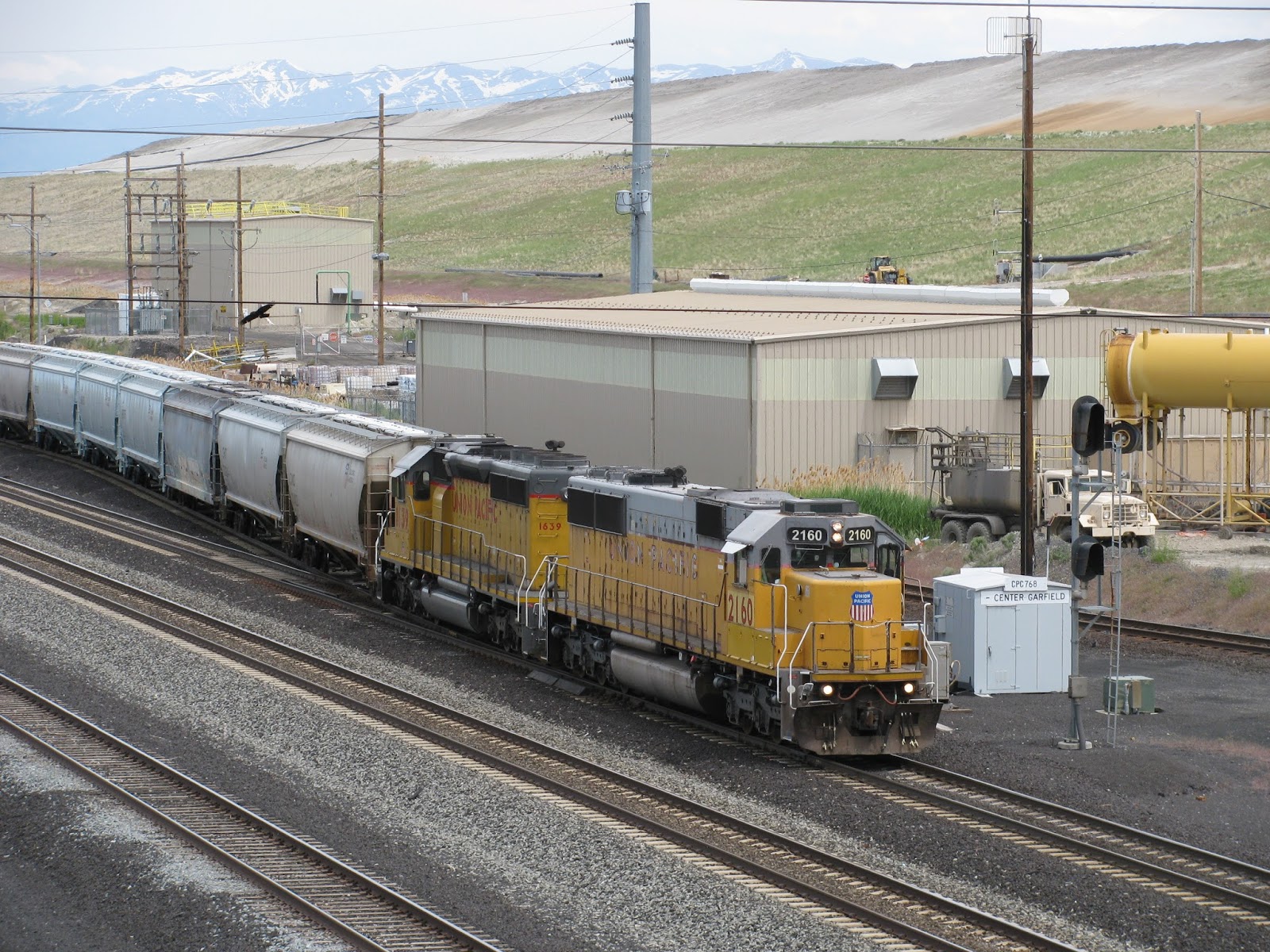
May 2017, the LUE46 works the Garfield Yard where it interchanges traffic with Kennecott's smelter.

May 2017, Later the same day as the previous photo, the LUE46 returns to downtown Salt Lake City having completed its trip out to the Tooele area and back.

Times have changed though. The stations in St. John, Stockton, and Warner vanished, some victim of fires. The resin plant in Bauer, the last rail customer in that area came to a close. The Tooele Valley Railway interchanged its last boxcar in the early 1980's with its rails pulled up a few years later. Finally a base realignment and closure action shuttered the repair portions of the Tooele Army Depot. By the 1990's the Chemical Weapons depot had severed its rail link, with its focus transferring to onsite incineration of the stockpile at hand. Kennecott's smelter and its neighboring industries, the occasional ammunition movement to Tooele's remaining base facilities, and a new feed silo in Erda would have kept the eventually re-christened "Warner Local" around but not very busy compared to its glory days in years past.

September 2016, with a load almost entirely consisting of sulfuric acid cars and a classic GP on point; what appeared to be the LUE46 departs North Yard in a bright fall morning as a Frontrunner commuter train rolls past it.

Recently though, the LUE46 "Warner Local" has been finding a new surge of traffic. The base realignment which shut down a corner of the Army Depot opened up new industrial areas in Tooele City and business began to move into the buildings the Army vacated. Where there once was military repair shops there now rises lumber yards, asphalt dealerships, businesses which require outbound shipments of boxcars containing finished products, and now a railcar re-manufacturing and repair shop which voraciously draws in beaten railcars to it. Across the rails in Warner Yard, a plastic water tank manufacturer Norwesco opened business a few hundred yards from where the Tooele Valley Railway joined the Union Pacific, and with it came the demand for a small but steady need of plastic granules. Further up the line, Kennecott's upgraded smelter began producing sulfuric acid caught in its pollution filtration system, an operation which demands a large fleet of incoming and outgoing white tank cars.

August 2017, on the edge of the Tooele Army Depot and the Peterson Industrial Depot the LUE46 with an interloping GE unit switch PID's rail yard.

In the modern day, the LUE46 leaves North Yard in Salt Lake City. It travels through the city limits, until it reaches the Garfield Smelter. In the interchange yard the job shuffles around boxcars of outbound copper anodes, inbound copper ore cars, and sulfuric acid tankers. Once done in Garfield, the train continues up the line and stops at a small warehouse on the edge of the Kennecott property. From there it heads down to Lake Point and into Erda, with grain for the Fassio Eggs feed silo. Once the train has reached Tooele it has several jobs to do, from servicing the Norwesco facility to dropping into the Peterson Industrial Park's former Army railyard to drop off cars for Peterson's own industrial switch engines to deliver to the myriad of business in the area park. It may also stop for loads from the Army depot itself, which still ships occasional ammunition cars. Then it heads back up north, picking up any outbound cars back in Garfield and returning late-afternoon in Salt Lake City. The train has regular appearances on Tuesday and Thursday; however the influx of traffic going into the Peterson Industrial Depot has meant the LUE46 often works jobs on all weekdays; Monday through Friday.

August 2016, the mid train set of a westbound stack train roll by. In the distance though is two sets of headlights; the furthest belong to the LUE46 as it works Garfield. The other is Kennecott's in plant switcher service which is operated by Omaha Track.

 March 2017, the LUE46 to the left is working Garfield while an eastbound work train rolls by.

My first experiences chasing the LUE46 were in 2013, when I had figured out the regular tempo of the train. SD40N units have been the dominant locomotive on the run, although SD60, GP60, and SD70M units all have made regular appearances on the train. GE  power is rare but does show up on occasion. Discovering this rhythm was one of my earlier railfan achievements, and something I remain happy to know in the present day.

The LUE46 is a great train to railfan, and its history is surprisingly deep below the surface level. Even if local trains no longer travel as far south into St. John; the spirit of the St. John local lives on in its present day incarnation.

-Jacob Lyman

Sources:
Leamington Cutoff Construction History (UtahRails.net)
St. John local in Salt Lake City meeting a DRGW train in 1973
St. John Local in 1977
St. John Local in 1977 (2)
St. John Local in 1993
Warner Local in 2010
Warner Local in 2011
Chemical Weapons Shipping History
Utah Rails Company List (Includes mention of the Beltline Railroad at the Chemical Depot)
Mining, Smelting and Railroading in Tooele County

See Also:
Provo's Ubiquitous Local Trains for more information on some local train action in Utah.


A close up of UP 1616 on the  LUE46 in March 2017. UP 1616 has been one of Utah's most prolific diesels having ran freights across the entire Wasatch Front. Its multiple appearances on the LUE46 over several years were what lead me to buy an HO scale model of this exact engine!

Wednesday, December 14, 2016

Snowfall: Railfanning in Downtown Salt Lake City

The snow got thicker than I expected and set the mood for the day pretty quick... Dramatic, cold, and hard to get good pictures in. But dang the atmosphere was awesome! The train pictured here was the second grain shuttle I had seen that day passing through CP 784.

Sometime nearly a year ago I made a joke in a Facebook discussion, that the decision to railfan in the snow is comparable to the scene in Star Wars: The Empire Strikes Back when Luke Skywalker is crawling in the snow; only for the ghost of Obi-Wan Kenobi to appear to him ordering him to seek out Yoda. I joked that in a way railfans have their "Obi-Wan" calling them into the snow despite their better judgement. On November, 28th; I had an "Obi-Wan" calling me to go snow railfanning when I got the news that Union Pacific's Denver & Rio Grande Western Heritage Unit (number 1989) was coming through Salt Lake City that day on the KOASCX-17. I couldn't resist, and had to get out trackside to catch the unit.


I have seen UP 1989 multiple times before; the first time being nearly five years ago on a train being held on the track behind the bowling alley in my hometown in Tooele, Utah. However, knowing many people online who miss the old Rio Grande; I had a newfound desire to see the locomotive again.


The yard switchers working the southern end of North Yard today were a SD40N and a GP15.

I decided to hunt for UP 1989 around CP 784, a control point at the southern end of Salt Lake City's North Yard. My first catches of the day was the familiar sight of the remote controlled yard switchers at work on the yard lead. UP 1956 was on point of the yard switcher, with its roof mounted strobe lights blinking to indicate remote controlled service. Behind it was the smaller UPY 582, a venerable GP15 which had once served the Missouri Pacific Railroad. The ex-MP GP's are still used as road switchers in the prairie country UP serves back east, but their small size and lack of dynamic brake units makes them ill suited to road work in Utah. As such in Utah they are confined to switching duties in the yards in Ogden, Provo, and Salt Lake. The growl of the EMD engines from the yard switchers made the area around CP 784 resonate with sound.


I also encountered a four legged friend at CP 784. The dog was a bit goofy, chasing my car and running into the railroad tracks. Fortunately he wasn't hurt, although he ran behind my car a few times while I was backing it up! He perhaps had better sense than I, and was gone when the snowflakes began to fall again.


One of the great things about railfanning Downtown Salt Lake City is the constant parade of Frontrunner trains. North Temple Station sees two Frontrunner trains meet each other every hour. Getting to see these trains plow through the snow reminded me of a Trains Magazine article from earlier this year which stated, "UTA has created a modern, comfortable, six-day-a-week operation in an area of the country that experiences snowy, below-zero winters and hot, dry 100-plus-degree summers. (David Lusting, Trains Magazine, July, 2016.) It wasn't yet "below-zero" today, but the air was hovering at freezing and the snow flurries made it clear that winter's onslaught was upon us. 


My first through-freight train catch of the day was a stack train being lead by four SD70M units (I suspect it was the KG3LB). The SD70M's are one of the most common units on the UP, but catching an entire train being powered by just  SD70M units is an increasingly rare sight. From conversations I have had with railroad employees, it seems the older DC traction units used on SD70M's don't make them quite as popular among train crews as the AC traction models which were released later. With that said, the SD70M is growing to become a railfan favorite engine, an opinion which is furthered thanks to the engine's unique production features. For example the train in the photo includes different production series of the SD70M from an earlier flat radiator model, to three flared radiators, and one cab with slights indents in the nose which was a harbinger of the future cab on the SD70ACe model.


UTAH 2006 and UTAH 2003 were on point on the Utah Railway train. Both engines are ex-SP units.

A few Frontrunner trains passed through after the stack train; and the snow began to fall at a furious rate. It was in this mini-blizzard like storm that a Utah Railway train began to peak through the fog and pull up alongside CP 784. The train pulled to a stop on Main 2, preparing to back up along Grant Tower so it could interchange freight cars (box cars, hoppers, and low-level radioactive waste) with the Salt Lake Garfield & Western shortline railroad. 


When the Utah Railway train came to a halt I was surprised by the attire the conductor was wearing when he left the cab! While the safety vest was nothing out of the ordinary, his festive Christmas hat instantly caught my eye. With heavy snow blanketing the area, it was easy to imagine that it was Santa Claus himself, conducting a train loaded full of goodies (and radioactive waste too!). It seemed as if this conductor had decided to make the best of a snowy day at work, by dressing the part!

Even in the snow, the fresh paint on UP 7719 is instantly noticeable!

After the Utah Railway train had backed down Grant Tower I saw the headlights of an incoming UP train. Was it UP 1989 after all my time waiting for her? No, to my surprise it was a unit train of grain hoppers being lead by UP 7719, aa AC45CCTE sporting a fresh paint job. The grain train rumbled slowly through CP 784, and I began to get anxious waiting for the eventual arrival of UP 1989. The storm kept getting thicker, only taking brief rests before kicking up again with even more snow!

 The snow stopped for a brief moment just as the Utah Railway train returned to CP 784. Having dropped most of its cargo off at the SLG&W interchange, the train was now carrying a short string of tank cars bound for the oil refineries north of Salt Lake City.


I was getting cold, and decided I needed to take a break from the tracks for a moment. I had gotten word that UP 1989 was still waiting for a crew change up in Ogden, so I made the quick drive to North Temple to pick up a hamburger! Railfanning in cold weather is actually a bit of a tricky challenge, and requires taking shelter in car and buildings to keep warm. My shoes weren't up to the task, and snow was melting into my socks. 


Shortly after I began eating my burger the snow began to fall again in earnest. The fog seemed to creep further in and blocked visibility. Headlights of trains were visible long before the train itself, and when I saw another set of headlights approaching on Main 1, I was hoping that UP 1989 had finally arrived! Instead it turned out to be UP 8194 heading the second grain train I had seen that day. The numberboards were lit up making the train even more visible in the soupy fog. 


A few more Frontrunner train whizzed by before I finally saw the familiar gray nose of UP 1989 pull into North Yard. The train was covered by clumps of snow, and the gray paint seemed to blend with the fog. I can see why the actual Rio Grande painted the noses of their units in a black and orange "zebra stripe" scheme; which surely would have been easier seen in a snow storm than UP 1989's gray hood! The locomotive stopped its train just short of the leaving the yard, and I would later learn that it was delayed here to wait for a train up ahead at the Salt Lake Intermodal Yard to clear the offloading area. I sat for 30 minutes or so waiting for UP 1989 to began the last leg of its journey. Finally a little bit before 4:40 pm, I saw the headlights of the engine brighten to cut their way through the fog as the train began to lurch forward. 


I tried to frame UP 1989's train underneath the signal bridge at CP 784 in a sort of recreation of a similar shot I had taken of Heber Valley's 1813 earlier this year (both engines are painted in a faux-Rio Grande inspired paint so it seemed appropriate!) The train crawled along Main 2 gaining speed as it rolled down to the Salt Lake Intermodal Yard. The golden orange sides of the locomotive were far more easier to spot in the snow than its gray nose, and seeing the Rio Grande flying letters conjured up images of yester-year when SD40T-2's battled their way across snowcapped peaks in Colorado and Utah. Of course with UP 1989 rolling out of sight I quickly jumped back into my car. I wasn't going to stay in that cold any longer! :)


Railfanning in cold weather certainly has its challenges and issues, but it also offers an amazing glimpse of railroads at work during even the harshest conditions. Even if my toes get a little cold, and my hands and face turn a bit red in the chill air; I always have fun railfanning in the snow! The sight of snow falling on the ground is one of the most stunning visuals of the intermountain west, signalling with it a change in seasons. Railroads are affected by snowfall, and watching them work in it is one of the most amazing ways to railfan.

Hasta Luego
-Jacob Lyman

Dedicated in memory of my Grandfather Rodney Lyman (March 26, 1937-December 12, 2016) who was with me and my father nearly five years ago the first time I saw UP 1989 in Tooele, Utah; parked behind the local bowling alley.