Showing posts with label branchlines. Show all posts

Thursday, August 17, 2017

Railfanning the Yellowstone Branch / Eastern Idaho Railroad

By Josh Bernhard
(Click on the links embedded in location names to see them on Google Maps.)

Right at the border of Yellowstone National Park is this monument to the railroad's influence in the development of the park.
Among all the states in the union, Idaho is one of the least represented states as far as railfanning. If you follow our Facebook page, the first photo I posted there of the Eastern Idaho Railroad received a slew of comments from Idaho natives who apparently took light-hearted offense at this idea. Apparently some thought that I meant that there are no trains in Idaho but I meant quite the opposite. It's true that there are great locations to photograph trains in Idaho but the state is on nobody's bucket list as far as places to visit, giving way to the Colorado narrow gauge, or Pennsylvania's East Broad Top, or California's dozens of excellent preserved lines. I think this is a shame considering Idaho has some amazing scenery and while daily traffic may not be on par with the Arizona Transcon, once you find a train, it is more than worth the effort. This is especially true of the old Oregon Short Line Yellowstone Branch, the line that opened the west side of Yellowstone National Park, established the town of West Yellowstone and brought thousands, if not millions, of people to enjoy the world's first national park before the age of the automobile.

The branch was built by the Oregon Short Line from 1905 to 1907 to tap into the growing tourist traffic that exploded in the late 1890s. Yellowstone National Park had railroad access via the north entrance from the Northern Pacific so the OSL sought to break open the NP monopoly and allow access for tourists from the southern half of the country. The west entrance and the town of West Yellowstone themselves are the direct product of the railroad and would probably have never existed without it - before the railroad began construction from Ashton, West Yellowstone was simply unsurveyed Forest Service land. Unfortunately Passenger traffic on the Yellowstone Branch ended in 1960 and the rails were torn up from West Yellowstone to Ashton. Today the remainder of the branch, from Idaho Falls to Ashton, is operated by the Eastern Idaho, a Wabtec company with the reporting mark WAMX. The line is fairly well known for its fleet of GP30s and safety cab Canadian GP40-2LWs, most of which are stationed on the western portion of the railroad. The northern portion, which operates the Yellowstone branch, uses mostly GP35s.

The Eastern Idaho Railroad operates the Yellowstone Branch using these smartly-painted black and yellow geeps.

If perchance you find your way to the old Yellowstone branch on the way to the park, the bad news is that trains are few and far between. In the four years that I worked in the Yellowstone area, I only saw one train on the branch, running North to Ashton in the late afternoon. Over the week that I was there in 2017 I saw two trains, one coming off the branch into the yard at Idaho Falls on a Friday afternoon and one leaving Idaho Falls on a Wednesday morning. In speaking to locals in some of the towns along the way they all agreed that trains run simply as needed, with no guarantee of when or how far they will run when they do. In addition the Yellowstone Branch has two smaller branches that break off, one at Orvin on the north end of Idaho Falls going to Newdale, and the other at Ucon going towards Menan. Neither of this smaller branches parallel a road for any good measure of distance apart from where they pass through towns so photographing a train on these lines is even more difficult.

The good news is that the main branch runs almost due north, so sunlight is good almost all day, depending on whether you take Highway 20 (afternoon) or the old Yellowstone Highway (morning). The downside to the Yellowstone Highway is that it is no longer an uninterrupted road but rather appears and disappears at random every few miles, so chasing a train will require hopping back and forth between it and Highway 20 where on ramps are available. Traffic on the Yellowstone Branch consists of three main commodities: grain, potatoes and fuel oils. Tank cars, hoppers and those white Union Pacific ARMN refrigerator cars are the staple rolling stock seen. Since agricultural traffic is largely seasonal, traffic levels fluctuate through the year as harvests wax and wane.


Potato packing plants are equally as common as grain elevators on the branch, playing well with the Idaho stereotype. Cruddy, rusty ARMN reefers are used for this service.

Your tour begins at Idaho Falls, where the Eastern Idaho Railroad interchanges with Union Pacific. A few daily UP locals from Pocatello terminate there and EIRR switching traffic is fairly constant throughout the day. The best time to see the yard is in the morning from the northern end, where a parking lot and street parallel it on a bluff giving a slightly elevated view. In the afternoons you can see the other side of the yard in sun from Centre Avenue (the Union Pacific end) and Emerson Avenue (the EIRR end).

The Idaho Falls yard sees a lot of traffic as EIRR and UP trains switch local industries as well as prepare trains to head out on the Yellowstone Branch. Here the Yellowstone turn pulls out of the yard while another GP35 switches in the background and an SD24 rests near the yard office.

Between Idaho Falls and Rexburg the branch is pretty straightforward, literally. A clean straight shot north with a siding here and there for potato packers. After Rexburg the tracks get a bit more interesting, curving a bit with more sidings branching off at right angles for sawmills and fuel dealerships. However, they run at an angle through the city so there is no one road that parallels them. Following the tracks involves a zig-zag going from one block to another until the track reaches the other end. Just make sure to stop at every track because Rexburg is the only city I have been to where every single grade crossing is protected with a mandatory stop sign - it is easy to forget this when most non-gated crossings are protected only with crossbucks.

This cluster of elevators in Rexburg looks like it may be built around the old freight depot. The building closest to the tracks looks very much like an OSL standard depot.
  
While in Rexburg, be sure to stop at Smith Park near the hospital to check out the steam tractor there. It is a monster of a machine.


At St. Anthony the elevator districts start cropping up and at Ashton the tiny town is filled and surrounded with a maze of spurs, sidings and a wye servicing Elevator Row right on Main Street. Ashton is in my opinion the most interesting of the towns, being the current end-of-track and former junction with the Teton Valley Branch that ran to Victor Idaho.

Garry, Idaho is a typical example of the scenery seen along much of the Yellowstone Branch between Idaho Falls and Rexburg. A potato packer is served by a spur at this location.

 The spurs at Thornton were being reballasted during my trip.
If you wish to continue from Ashton for a bit of ghost railfanning, the grade for the old Yellowstone Branch has been reclaimed by fields. However, it turns east to parallel the Henry's Fork River until it pops out as the Yellowstone Branch Line trail at the Warm River Campground just off the Mesa Falls Scenic Byway. No roads parallel the trail for a long time but it can be hiked or biked through Island Park to West Yellowstone (more on that later). The Teton Valley Branch likewise runs far away from any parallel roads until France Idaho where it more or less parallels the road to Tetonia. The abandoned elevators along this line are as interesting as the railroad grade itself. From appearances where it crosses roads it appears that it is an open access road, but I have not been able to confirm how much is driveable.

Ashton's elevators have their own trackmobile to switch cars when an EIRR locomotive isn't around.

Regardless of whether or not you decide to search out the abandoned grades, the best part of ghost railfanning this line is at the terminus at West Yellowstone. There, the Union Pacific depot, baggage building and Union Pacific Lodge still stand, donated to the City of West Yellowstone. The depot itself is an excellent museum (entry fee $6.00) with a short bit of track relaid along the platform and a car from the Montana Centennial Train representing the once busy passenger traffic on the branch bringing tourists to the park.


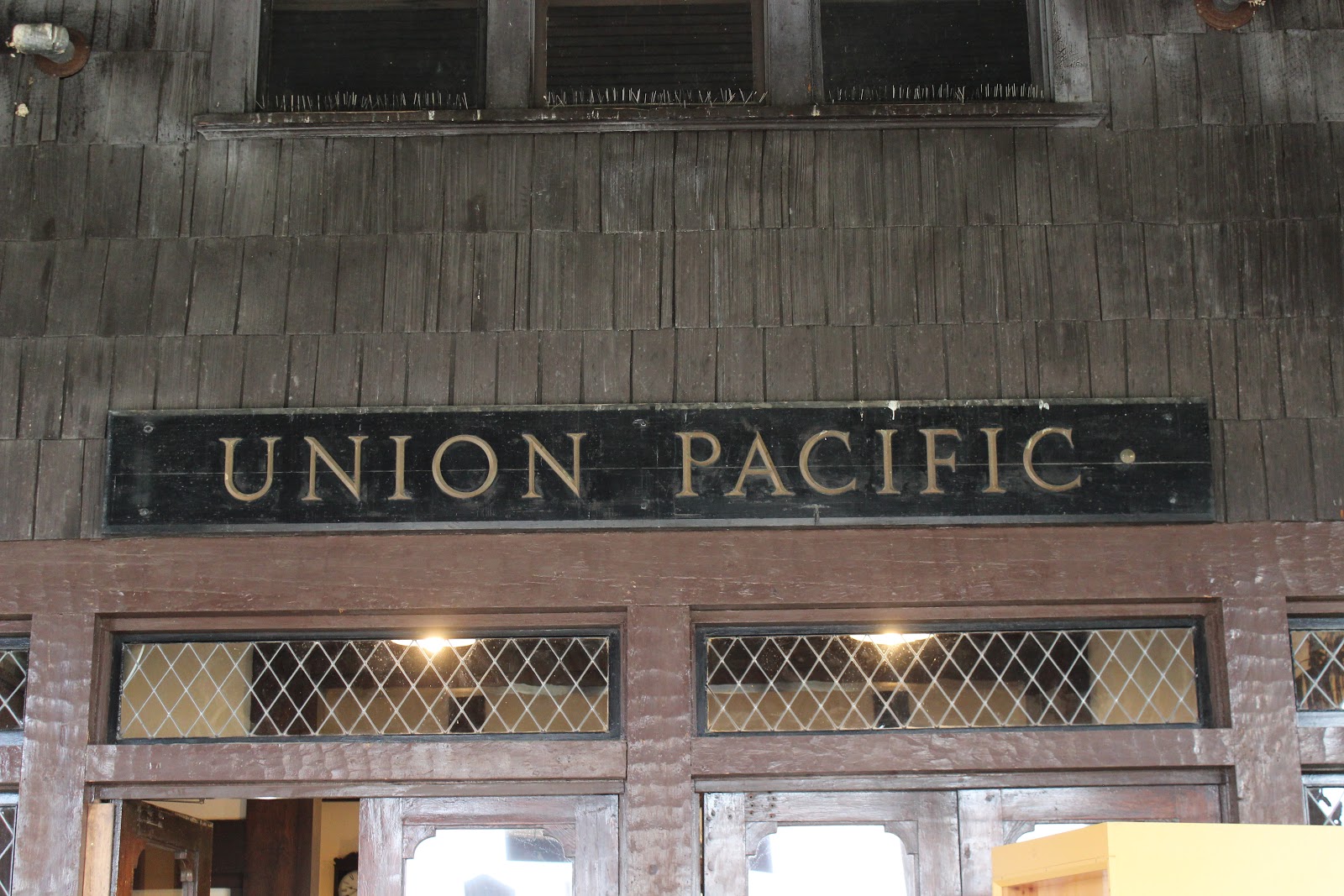


Just to the east of the depot are the baggage building, now used by the West Yellowstone Police Department, and the Union Pacific Lodge. Interestingly, the linens from this huge hotel were shipped by train to Ogden Utah where the world's only railroad-owned industrial laundry facility existed. The building still stands and is part of the Utah State Railroad Museum complex although it is closed to the public due to its poor structural condition.

This little stretch of track is a definite bonus to a vacation to the park, so next time you head to the Yellowstone/Teton area be sure to look for it. Maybe you'll be lucky and get some great shots.

Links
Eastern Idaho Railroad website
Eastern Idaho Railroad on Railpictures.net (check out Russell Watson's pictures of the Yellowstone Branch)

Friday, October 21, 2016

Provo's Ubiquitous Local Trains

 The LUL44R returning to the Provo Yard after a day of switching the Provo Industrial Lead on April 1, 2016. On this day it was led by an ex-Seaboard, ex-Southern Pacific GP40M-2.

Mainline operations are fascinating. They're big, loud, fast, and above all, exciting. I would estimate that around 80% of railroad photographs are of mainline hotshot trains, and understandably so, but often the local trains are where the true interest can be found.

Locals, on the other hand, are slow, small, and often run through isolated areas. However, they often run on a more reliable schedule than mainline operations do. While it is hard to say when a freight train will be on the Sharp Subdivision, the two local trains that ply those rails run like clockwork, leaving at the same time each day and returning at a reliably consistent hour. Through summer 2016 I generally had weekday mornings off, so around 8:30 am I was usually at Kuhni's on the south end of the Provo Yard to follow the LUL57 which left at that time. My vehicle probably became very familiar to the crews.

The LUL57 approaches the Provo Yard on June 1, 2016. After passing through the derail, the train will meet the Ringling Bros. Barnum & Bailey Red Train, which is waiting to take its place on the Sharp Sub to head to Las Vegas, Nevada.

Provo has three main locals that originate in its yard. Two of them, the LUL57 and LUL58, run down the Sharp Sub, the 57 usually terminating at the grain elevator at Sharp and the 58 terminating at the Intermountain Power Project plant southwest of Lynndyl, where the Sharp and Lynndyl subdivisions meet. The third, the LUL41, runs down the former D&RGW Tintic Branch to Spanish Fork, then returns to switch the Provo Industrial Lead to the North. All three of these trains generally use rebuilt SD40Ns, except when accidents occur or tonnage is expected to be high, in which case SD70Ms are added. This was not always the case; the SD40N rebuilding program (starting with older SD40-2s) only began in 2011 and it has only been in the past two years that they have become common as switching and local power in Utah. Before then, SD60Ms and SD70Ms were operated in tandem, at least on the 57 and 58 which travel much further than the 41, and at one point D&RGW SD40T-2 "tunnel motor" number 5342 was assigned to the 57 in 2001.


Here, the LUL58 with 27 cars straggles into a very wet Provo at noon on September 24, 2016. The LUL57 had derailed the previous day at 9:00 am at Longview Fiber in Spanish Fork and didn't get back on the road until 1:00 am on the 24th, delaying the arrival of this train.
 
The LUL58 leaves in the afternoon, usually between 3:30 and 5:00. Here, the two trains on the left are waiting their turns to head out on the Sharp Sub, while the three light locomotives will run down the yard lead to the Intermountain Power car repair facility to pick up its train there. The LUL58 is the train on the far left with two SD40Ns and one SD70M.


An exception to this pattern occurred on July 26 2016 when the LUL41 split a switch on the Provo Industrial Lead, so until the SD40N usually assigned to the train could be rerailed, it ran with an ex-Missouri Pacific GP38-2. It is interesting to note that six-axle locomotives never ran on the Tintic Branch when it was owned by the D&RGW; after testing an SD7 in 1976, the Grande decided that the rigid trucks were just too long to traverse the branch. Now that the branch as been severely truncated, the little remaining track seems to handle it.


The LUL57 runs daily on weekdays, leaving at 8:30 am and depending on how many trains it meets on the Sharp Sub will arrive in Lynndyl around noon. This is the general service train, switching out all of the industries between Provo and Lynndyl. The 58 departs in the afternoon on Mondays, Wednesdays and Fridays, arriving in Lynndyl sometime around midnight. This train services the IPP plant and Magnum facility (which are next to each other), dropping off empty covered hoppers and picking up filled ones full of fly ash (a byproduct of burning coal) from IPP and delivering tank cars of Liquid Natural Gas to Magnum. If either industry needs service on an off day another train will be dispatched under the symbols LUE88X or LUL58X. The LUL41 switches the Tintic Branch on Tuesdays and Thursdays; any other day it operates only on the Provo Industrial Lead.

Spanish Fork's UP Harriman Standard depot is sadly dilapidated, but the tracks that pass in front of it are well-used. Here the LUL57 speeds by on its way south. On this day, the normally predictable power was interrupted by the addition of an AC4400CW and an AC45CCTE.
After escaping the yard limit in Provo, the 57 books it from one industry to another. Unless it stops to switch somewhere, it's hard to keep up with it on the rural roads.


It is interesting to observe the differences between the commodities carried by these trains. The 41 is guaranteed to have bulkhead flats full of lumber on the days it runs on the Tintic Branch; the 57 generally consists of TTX boxcars and covered hoppers badly rusted by salt; and the 58 is generally almost a unit train consisting exclusively of two-bay fly ash hoppers and tank cars of liquid natural gas.


For more information about these locals, Spencer Peterson has compiled everything you could possibly need to know about them on his website at UCrail.com, including radio frequencies, locations, and a map.


Monday, October 10, 2016

Trekking Around Kennecott's Abandoned Railroads

October 3, 2016; the crown jewel of "The Desert Empire"? The history of railroading to extract copper in the American West is rich and detailed. In fact the documentary The Desert Empire for which this blog is named, spent a large segment about copper mining in Bingham Canyon. Although the Rio Tinto/Kennecott Copper Mine no longer is crisscrossed by tracks, its history with railroads is still around, hidden in plain sight.

"Mining in the American West." That short phrase instantly calls forth pop culture ideas deeply rooted in the minds of many American's. The ruthless barons, the prospectors who traveled great distances to find gold and silver deposits. The men who became rich, and those who lost everything. Outlaws such as Butch Cassidy robbing trains loaded with gold, while being hunted down by county sheriffs and federal marshals. It seems the thought makes us want to yell "There be gold in those hills!" and try our hands at panning for gold. Even our favorite theme parks take us on the "The Wildest Ride in the Wilderness!" with roller coasters based on failing gold mines. Considering it has been over a century since that era, it is still deeply rooted in the collective psyche of the American experience.


October 3, 2016; abandoned railroads aren't the only artifact in Copperton. The Bingham City cemetery is located near the abandoned tracks. Many of the graves were relocated from cemeteries which were in locations that were swallowed up as part of the ever expanding mine operations. The town of Bingham no longer exists itself, having been destroyed by the ever growing copper mine.

With all of our pop culture conscious of western mining, we also have an attached image of ruin and failure. The mines that died up, the towns that vanished, the people that moved on, and the history lost as nature reclaimed the area for itself. (Perhaps the more cynical mind might recall the image of EPA Superfund programs to clean up polluted sites that have resulted because of those abandoned mines.) Some of these abandoned or less active mining areas have put themselves on the map as tourist attractions, such as Virginia City, Butte, Ely, and Utah's own Park City. 

Of course there is one mining discovery from the old west that has not died, and is still at work many years later; the famed Bingham Canyon copper claims. The Oquirrh Mountains were once full of other mines which have since dried up and vanished, such as the mining districts in Ophir and Mercur; but Bingham continues to work, despite the changes in ownership, stricter environmental laws, and even the oddball natural disasters. The Bingham Mining District has produced Gold, Silver, Copper, and Molybdenum through out its long history. 

October 3, 2016; the abandoned Copperton Yard was part of Kennecott's busy electric freight railroad; which was later converted to a diesel operation. The majority of the railroad was shut down at the turn of the 21st century, leaving behind only the switching tracks still in use at the Garfield Smelter.

May 31, 2016; for a time the electric railroad operations in Bingham Canyon and its environment were ruled by these tall 125 Ton electric units which were nicknamed "Magna Motors." KCC 402 is pictured here, preserved near Grantsville, Utah. To my knowledge this is the only "Magna Motor" that is still in Utah, the other members of the class have been preserved elsewhere or scrapped.

Of course one rapidly vanishing aspect of Bingham Mining history is its railroads. A system of conveyors and slurry pipes have replaced the need for a railroad in the area; what once required many ore trains is now done with building-sized dump trucks and pipes which send copper ore on a journey from the Copperton Concentrator to the Garfield Smelter. Kennecott's Utah operations were one of the last mining railroads in the inter-mountain west. Now the railroad's tracks sit abandoned, their right of way mostly intact; but without having hosted any rail movement in over a decade. In a way the history of the Kennecott railroad mirrors the fates of other mining and smelting railroads such as the Virginia & Truckee, the Tooele Valley Railway, the Nevada Northern, the St. John and Ophir, and the Butte Anaconda & Pacific. As technology has changed, so has the need or use of these railroads.

 October 3, 2016; the Denver and Rio Grande's Bingham Branch has been cut from reaching the mine it once served. A few parts of the line (and its sister routes in the area) do remain in use as part of UTA's Red Line for TRAX light rail trains. At night Savage and Utah Railway switch a few of the rail served industries along  the UTA route, and also operate a branchline which still connects to the Garfield Smelter.

October 3, 2016; these abandoned foundations of a roundhouse were once part of DRGW's Welby Yard in South Jordan. This roundhouse appeared to have five stalls, and would have serviced engines that worked the branchlines to Bingham and Garfield. Part of Welby Yard remains in use by Savage and the Utah Railway as evidenced by the tank cars in the background.

Fortunately, parts of the history of the Bingham Canyon railroads are still with us. Kennecott has promoted its history rather extensively in the Intermountain West, with displays in several locations near their operations. The Utah State Railroad Musuem has part of a former Kennecott caboose preserved as an interior exhibit highlighting the history of cabooses. A few Kennecott pieces of rolling stock are preserved near Grantsville, Utah. Even the Nevada Northern Railway Musuem was created when Kennecott donated the operation to the citizens of Ely, Nevada. It seems Kennecott was well aware that preservation of its history makes for a great publicity tool!

 March 10, 2016; although the majority of the history of the Nevada Northern was as a separate entity from the history of Kennecott's, it was Kennecott who owned the operation in its final years and ultimately donated it for the purpose of historical preservation.

However, the most interesting remnant of Kennecott's Utah railroading operations is the Garfield Smelter. Unlike the pit railroads, or the ore line between Copperton and Garfield; the track within the Smelter remains constantly busy even in the present day. Rio Tinto (Kennecott's modern day owner) has continued to grow the operations at Garfield. Some of the locomotives that once worked within the mine, and hauled ore trains out of Copperton; have found new life as the switchers which keep the busy smelter supplied and operating. The tracks within the smelter are vital to the process of refining copper ores. After the ore is smelted and cast into anodes, the anodes are loaded into open flatcars. A cut of locomotives will haul these heavy flatcars the short distance to the refinery building, where electric baths will extract any trace mineral within the anodes, and purify the product into 99.9% pure copper. Passerby's on I-80 and Highway 201 might catch a glimpse of this process as the flatcars are moved from building to building.  From the refinery, the finished anodes are loaded into unassuming boxcars which are then shoved down to the interchange track with the Union Pacific. The plant also generates sulfuric acid, which is loaded into tank cars and switched to form a unit train block which is sent out via the Union Pacific. Individual car loads of sulfuric acid can be taken by Savage and Utah Railway to be delivered to BNSF's yard operations in Provo. A large portion of the yard tracks at the Garfield Smelter are full of cuts of these sulfuric acid cars, waiting to be loaded and shipped out. (A virtual tour of current Rio Tinto/Kennecott operations; including the anode flat cars, can be found at this website.)


October 18, 2015; the last class of locomotives to rule Kennecott's ore trains between Copperton and Garfield were these GP39-2 units. Originally these units were used on tracks within the mine itself, the high cabs allowing crews to have high visibility while traveling the track within the pit. The large numbers painted on the sides allowed crews working in the pit the ability to easily identify the locomotives. A handful of these unique engines are still in service at Rio Tinto/Kennecott's massive Garfield Smelter. Here they are seen hauling tank cars of sulfuric acid from the interchange track and into the the smelter complex. 

Perhaps in an ultimate twist of irony, ore trains have indeed began to return to Garfield in the 21st century. But they are no longer hauled by Kennecott itself from their own mine, instead they originate in copper mines across the county; hauled by Union Pacific to be delivered to Garfield. At times the locomotives to transfer those ore trains from Union Pacific tracks and into the smelter, are the veteran GP39-2's which were built to haul ore trains for the bygone Kennecott railroads. Sometimes the past finds a way to repeat itself in the present day.

July 2, 2016; the OGLGD an ore train bound for the Garfield Smelter, travels through Erda, Utah, on Union Pacific's Lynndyl Subdivision. These modern trains could perhaps be seen as the reincarnation of the ore trains which once fueled the Garfield Smelter many years ago.

September 8, 2015; one of Kennecott's largest outbound shipments is Sulfuric Acid, which often travels in a unit train from Garfield to a fertilizer processor in Idaho. That train is seen here at Cache Junction on the Ogden Subdivision, as it makes its journey north.


Septemeber 11, 2016; not all of Kennecott's outbound shipments are part of unit trains. Here on a BNSF Provo-Lincoln manifest on the former Rio Grande north of Thistle, is a Kennecott marked Sulfuric Acid tank car being shipped to points out east.

Even though the sprawling operations of Kennecott's ore hauling railroad have come to an end, the rail traffic in and out of the Garfield Smelter attests to the successful history of mining in Bingham Canyon, and the continued use of railroads to transport the mine's finished goods.

Hasta la proxima vez,
-Jacob Lyman

For more information on Rio Tinto/Kennecott's history I would recommend visiting Don Strack's To Move A Mountain page on his Utah Rails website.

Friday, September 16, 2016

The Cache Valley Branch, a Window into Yesteryear

This photo from the Library of Congress's online web archives shows the starting point of the Cache Valley Branch as seen circa 1933. From here the Cache Valley Branch connected into the Oregon Shortline Railroad's mainline from Ogden to Pocatello Idaho (the modern day Union Pacific's Ogden Subdivision)


In the early days of railroading, branchlines and shortline railroads served a crucial role in connecting small towns and industries into the national rail network. In an era without Interstate Highways, Semi Trucks, and a gas station every couple hundred of miles, branchlines were often the only way to bring goods into a small city. In some cases branchlines served large industries on the edge of an urban sprawl. Famed branchlines in Utah included the Denver and Rio Grande Western's Bingham Branch (Midvale Tramp), the Tintic Branch, The Marysvale Branch, the Heber Branch; the Western Pacific's Warner Branch; and Union Pacific's branches to Little Mountain, Cedar City, Malad Idaho, and the Cache Valley Branch.

In many cases the post-war era changed the operation of branchlines and lead to many being abandoned or converted into other purposes. For example part of the DRGW's Heber branch became the modern day Heber Valley Railroad, while the remainder of the line was abandoned. The Bingham and Garfield Branches owned by the DRGW (affectionately known as "The Midvale Tramp") would be cut of from Copperton, and were partially converted into the right of way served by the UTA Trax Red Line (freight service continues, after the fall of night). Both the Warner Branch (WP) and the Little Mountain Branch (UP) fell after mergers made their purpose redundant, seeing that the railroad acquired in the merger owned a mainline to the location the branch had served. Some of the branchlines were destroyed by natural disaster, as was the case when the Thistle Landslide cut off the Marysvale branch from the rest of the DRGW system, leading to the DRGW to abandon the rest of the line. Other branchlines have become caught up in scandal and theft, as the fate which befell the Tintic Branch just this year when businessman Al Mckee hired a scrapping agency to 'remove' the line illegally for the purpose of selling off the scrap (a bizarre story that deserves to have it's own post on this blog someday...).

This view taken by the author on August 23, 2016 at Midvale Utah shows the transformation of the Denver and Rio Grande's branchline to Bingham and Garfield, into the modern day UTA Trax Redline. The line does remain in use by freight trains (as evidenced by the boxcar in the industry at the right, and the distant freight locomotives idling down line), but the freight trains are now forced to work it at night after UTA operations have been silenced for the day. The modern look of this location contrasts with that of historical photos of the line in operation, as seen in the link to 1994 photo of this location (linked photo by James Belmont): http://www.railpictures.net/photo/469938/


But while many branchlines have fallen, a few still remain in service, intact and still making a living. One of the most resilient branchlines in Utah is the Cache Valley Subdivision, a stretch of track from the far end of Cache Valley, down into Hyrum, and then back up into Preston Idaho. While the equipment might be modern, the modern day workings of the line are not far removed from the work done on it say 50, 60 or 70 years ago. During my time at Utah State University before I transferred schools, I had the ability to frequent the line and record it's operation and history.

This shot taken on September 8, 2015 by the author is at Cache Junction, the same location as the 1933 photo at the start of this article. UP 3687 (SD40-2) and UP 1977 (SD40N), are seen here after having exited the lead into the Cache Valley Branch, and taking a load of covered hoppers to the grain silo at Trenton.

On a normal operating week the Cache Valley local operates at a predictable and steady pattern. Departing the Union Pacific yard at Brigham City, the train travels north through Wheelon and then travels south into Cache Junction. The train crew ties up for the night at the junction, departing Tuesday morning for the JBS Swift slaughterhouse and meat processing facility. After switching at JBS, the crew ties up at Logan, Utah right besides the historic depots preserved there. Wednesday morning takes the train up from Logan and at least as far as Presto, a plastic products plant located in Lewiston, Utah. If needed, the train will run further up into Preston, Idaho at the terminus of the branch. Once all work upline is completed, the crew returns to tie up at Logan.

Thursday's schedule works as Tuesday's in reverse, the train leaves Logan to work at JBS Swift again, then it comes to Cache Junction. If necessary, the train will travel up the mainline to Trenton to switch out a grain silo. Friday morning is the return trip to Brigham City. 

This regular (almost clockwork) pattern of work, plus the scenery of northern Utah; has made the Cache Valley local run one of the favorite trains to chase for railfans in Utah. A yearly tradition is beginning to emerge called "Cache Valley Rails" were rail enthusiasts from as far south as Salt Lake City, will be gathered in Logan, Utah as early as 7:30am to catch the movement on the rail line. 

June 8th, 2016; evidence of the popularity of the Logan Rails event is shown here in this photo taken south of Smithfield Utah. A line of cars belonging to the attending railfans' is parked at the side of the road, with their occupants standing trackside, waiting for the perfect shot of a southbound photo of the Cache Valley local. Below is a photo of the local lead by UP 1736 (SD40N), once it arrived at the group's location.

Of course this clockwork regularity on the Cache Valley branch can be easily disrupted by the arrival of northern Utah's harsh winter storms and cold spells. A particularly harsh storm hindered the line's work in the first week of Febuary 2016. Since many portions of the line only see a train once or twice a week, snow removal is infrequent. As snow melted, water slipped into the joints of rail at road crossings, were it then froze in place. The passing cars above melted the ice again, and further compressed it in between the rails and the roads. When the train finally arrived to travel the line, the railroad discovered it was almost impassible due to the ice frozen in their path. Maintenance of Way crews worked at cleaning out the rails, while the train slowly crept through the line. Trips that would only have taken an hour or two on a clear line, became gruelingly slow 8 hour journeys. 


Febuary 4th, 2016; the storm crippled Cache Valley Branch show's evidence of slow progress cleaning the rails. The train is tied up at Presto in Lewiston, Utah; and not it's normal location in Logan, Utah. This is evidence suggesting the long trip to clear out the snow to this point of the line resulted in the crew reaching their legal work shift limits, and rather than return the train to Logan, the decision was made to leave it at Presto. The broom left hanging on the hood of the UP 1729 (SD40N),helps to covey the sense of struggle against the snow. UP 2327 (SD60M), is the trailing unit in the consist.

The second photo was taken on the same day near Franklin, Idaho; showing a portion of the line that had yet to have been cleared.

On Febuary 16, 2016; evidence of Utah's fast changing weather is seen on the Cache Valley local at Logan Utah. Only a few weeks after the disastrous snowstorm, the line is now clear, as snow begins to melt away from it. The blue sky stands in stark contrast to the whiteout that dominated only a few weeks earlier.

Of course one of the greatest assets of any branchline is it's sense of history. In some areas the Cache Valley Branch traverses, few has changed in a hundred years. Near the line is a large collection of abandoned rail spurs and industries, testimony of a once busier line that saw daily rail service. One of the railroad treasures of the line though is the amount of preserved stations. Next to the track's in Logan, the old station stands having been preserved as a Mexican restaurant, south from it is the former freight depot, itself having undergone a miraculous restoration. It is easy to imagine the era when these rails were not ruled by SD40's or SD60's; but traveled by 2-8-0's and GP7's. 

June 26, 2013; at Heber Utah. The Union Pacific 618, the famed 2-8-0 currently being restored on the Heber Valley Railroad; is recorded to having worked from 1945 to 1955 on the Cache Valley Branch. https://hebervalleyrr.org/ourtrain/help-get-the-no-618-back-into-service/ 

September 30, 2015; Logan, Utah. The Logan Utah train station has been restored, and now houses the restaurant Cafe Sabor. The tracks behind it still remain in use as part of the Cache Valley Branch. Nearby is the preserved freight depot, and a few blocks away is the current location of the former Smithfield depot. The valley also hosts a few stations left over from the Utah Idaho Central, an interurban electric railroad that ran from Ogden to Preston.
May 3, 2016; this building (currently a private home) north of Mendon bears witness to having once been a rail served industry. The windows are built into what was once the loading docks. Allegedly this building once served farmers who transferred equipment and goods to the railroad here.
May 28, 2016. An abandoned sugar factory in Preston Idaho, is yet another relic from an era were the branchline served many large agrarian based industries. South from here in Richmond Utah, is another large abandoned factory located near the rails.
 May 24, 2016. An abandoned spur leading towards grain silos in use by IFA in Logan. This spur once lead to a condensed milk factory and the silos pictured here.
Yet another abandoned spur as seen on Febuary 27, 2016 at Smithfield, Utah. The Morgan Pea Company (later part of the Del Monte brand), was one of the largest shippers on the Cache Valley branch, and one of the largest sources of rail traffic on the line. The tracks remain mostly intact leading into the facility, although it is unlikely that they will ever see use again.

The ability to feel like one has stepped back in time is ever present on a small town branchline. Simple and steady operations combined with eclectic bits of history help to convey the sense that something truly special exists with this rail line. Of the many branchlines that once existed or still serve Utah, the Cache Valley branch has a special character that is truly unique. 


June 8, 2016; a few of the rail movements captured at the Logan Rails event was the rare sight of a self powered rail crane, moving along the branchline. Another sight of the day was UP 1736 running long hood forward, and with only one hopper in tow, proof of the fluctuating nature of traffic on a branchline.

Until next time,

-Jacob Lyman