Showing posts with label Springville. Show all posts

Tuesday, February 14, 2017

Snow and Water and Floods, oh my!

by Joshua Bernhard

I was told by the park rangers at Arches National Park that water is the most destructive natural force in existence; even if not absolute in that sense, it is still the bane of transportation and settlement in desert and mountain locales. The winter of 2016-2017 has been very strange, dumping snow at much higher levels than the average in the Rocky Mountains. Then, suddenly in late January, temperatures in the Great Basin soared from below freezing during the day to 65 degrees, weather more suited for March or April. Sudden spikes in temperature melt snow too quickly for it to settle, making snowpacks unstable in addition to simply increasing the amount of flowing water. Then, to make matters worse, rain hit the valleys, adding an extra layer of fresh snow at higher elevations; every variable was perfectly in line for catastrophic floods.

Everything collapsed at once it seemed. On February 7 there was a washout just east of Wells Nevada on the Shafter Sub; Amtrak's California Zephyr was reroute on the Lakeside Sub over the Lucin Cutoff through Ogden on that day. The following morning, though, conditions became worse and Amtrak suspended service, turning the eastbound CZ to return to California at Wells and the westbound CZ to return to Chicago at Salt Lake City. 21-Mile Dam near Montello, Nevada, burst under the sudden weight of floodwaters, and the stored water rushed out, wiping out roads, railroad, and inundating the town of Montello. This dam break shut down both the Lakeside and Shafter subs while UP began placing ballast trains in sidings in preparation for the repairs. Meanwhile, mudslides in the Sierra Nevadas (including at Doyle, California) shut down much of northern California and flooding in Central California caused a derailment of several cars. By Thursday November 9 the Lakeside, Shafter, Fresno and Roseville subdivisions were all closed; UP apparently gave up on trying to reroute trains out of Salt Lake City and let them pile up at Garfield.

(Photo and commentary courtesy Jacob Lyman) "When possible I try and chase every Amtrak train I get the opportunity to, especially since daylight Amtrak runs through Salt Lake City are such a rare occurrence. On February 9, 2017 I rushed from my classes at the university to get down trackside to watch as Amtrak Train #6, the eastbound California Zephyr departed Salt Lake. The delays were a result of the flood waters though out Nevada. I didn't stop to think though that it was going to get even worse over the next few days."


(Photo and commentary courtesy Jacob Lyman) "The full extent of the flood damage though became apparent the next day (February, 10) as I traveled with my sister driving home. I sat from the passenger seat of the car and declared to my sister I could see a traffic jam; however realizing that she thought I saw a jam up ahead on the road I had to quickly clarify I was seeing a traffic jam of trains. Here in the northern reaches of the Lynndyl Subdivision right before entering the Shaffter at Garfield Junction; where five trains lined up in a row, as a sixth train trundled past them. I had no doubt they were being held due to the flood waters, and I snapped a few pictures from the passenger seat with my cellphone. I was astonished, I had never before seen such a system delay concentrated all in one place. I learned later in the day the Shaffter was operating in limited capacity, as I saw a railfan post a video online of a stack train racing through the route (stack trains have been a rare sight on this route since the UP-SP merger). On Saturday (February, 11) when I passed through the area gone were the idle freight trains, but instead two ballast trains resting in the sidings. They were facing eastbound, and it made me wonder if they were called up from the ballast quarry near Milford. Either way the two ballast trains in the area made it clear, the railroad was preparing to go to war with nature itself."

By late that night the Shafter sub was reopened briefly although the condition of the route through the Sierras is still questionable. The Lakeside saw considerable damage on both the Nevada and Utah sides of the border; Box Elder News Journal posted pictures of minor washouts at Lucin that took out a grade crossing and signaling equipment on February 10. That same day BNSF made the decision to reroute their trackage rights trains south over the Sharp Subdivision rather than try to push them through Salt Lake City and the floods to the west; the Provo, Utah to Stockton, California Manifest (FHPVOS-10) left Provo on the morning of February 11 but rather than going to Stockton was forced to terminate at Barstow.

BNSF trains are never seen on UP's Sharp Subdivision, but it took catastrophic floods to make it happen. Here the FHPVOS-10 passes through Benjamin, Utah, rerouted to Barstow rather than its normal terminal of Stockton due to the closure of both the Lakeside and Shafter subdivisions out of Salt Lake City where it is normally routed. Even before making it all the way out of Provo it was met by floodwaters.

Another freak storm passed through on the night of the 10th however, dropping about an inch of snow in Utah Valley overnight but then warming up through the morning. Just before the FHPVOS pulled out of Provo Yard at 9:00 am it was met with a report that the Hobble Creek Bridge, less than a mile out, was blocked and flooding almost to the rails. The train was able to make it over the bridge on slow order, but water kept rising and after UP was able to push two more coal trains through right after the FHPVOS the water covered the railhead and the Sharp sub was closed for a few hours just before noon until Springville City could position heavy equipment to start fishing out the log jam that was causing the water backup. Even with water flowing under the bridge again by 12:30 the surrounding land was still 1-2 feet under water and nearby roads and industries were closed.

 This was the condition of the Hobble Creek Bridge at 9:30 am, just outside of Provo Utah on the Sharp Subdivision. The water had risen above the bottom of the bridge deck and was still rising; luckily Springville City, after the county sheriff, local police and a volunteer fire department had all responded to reports of the potential for damage. This location features four bridges in rapid succession: a street, the Sharp subdivision, Intermountain Power's car repair yard, and another street.

Once the water on the road reached two feet the street was closed.

Springville City was proactive and sent down equipment to start clearing out the log jam on the bridge by noon. They were able to bring water levels back down to below the bridge height, although only a few inches below the bottom of the deck.
Westbound freight trains continued to pile up, extending outward from Salt Lake City up the Salt Lake subdivision to Clearfield; however, while the damage caused across the UP system is significant and will take a long time to properly rectify, quick work has been able to prevent further closures and the fact that the Shafter Subdivision was reopened so quickly, even if under very limited operation, is a testament to the railroad employees who dove in to fix the problem. We still have a few weeks to see what else this winter will throw at us but hopefully nothing as extreme as this past week.

Friday, October 21, 2016

Provo's Ubiquitous Local Trains

 The LUL44R returning to the Provo Yard after a day of switching the Provo Industrial Lead on April 1, 2016. On this day it was led by an ex-Seaboard, ex-Southern Pacific GP40M-2.

Mainline operations are fascinating. They're big, loud, fast, and above all, exciting. I would estimate that around 80% of railroad photographs are of mainline hotshot trains, and understandably so, but often the local trains are where the true interest can be found.

Locals, on the other hand, are slow, small, and often run through isolated areas. However, they often run on a more reliable schedule than mainline operations do. While it is hard to say when a freight train will be on the Sharp Subdivision, the two local trains that ply those rails run like clockwork, leaving at the same time each day and returning at a reliably consistent hour. Through summer 2016 I generally had weekday mornings off, so around 8:30 am I was usually at Kuhni's on the south end of the Provo Yard to follow the LUL57 which left at that time. My vehicle probably became very familiar to the crews.

The LUL57 approaches the Provo Yard on June 1, 2016. After passing through the derail, the train will meet the Ringling Bros. Barnum & Bailey Red Train, which is waiting to take its place on the Sharp Sub to head to Las Vegas, Nevada.

Provo has three main locals that originate in its yard. Two of them, the LUL57 and LUL58, run down the Sharp Sub, the 57 usually terminating at the grain elevator at Sharp and the 58 terminating at the Intermountain Power Project plant southwest of Lynndyl, where the Sharp and Lynndyl subdivisions meet. The third, the LUL41, runs down the former D&RGW Tintic Branch to Spanish Fork, then returns to switch the Provo Industrial Lead to the North. All three of these trains generally use rebuilt SD40Ns, except when accidents occur or tonnage is expected to be high, in which case SD70Ms are added. This was not always the case; the SD40N rebuilding program (starting with older SD40-2s) only began in 2011 and it has only been in the past two years that they have become common as switching and local power in Utah. Before then, SD60Ms and SD70Ms were operated in tandem, at least on the 57 and 58 which travel much further than the 41, and at one point D&RGW SD40T-2 "tunnel motor" number 5342 was assigned to the 57 in 2001.


Here, the LUL58 with 27 cars straggles into a very wet Provo at noon on September 24, 2016. The LUL57 had derailed the previous day at 9:00 am at Longview Fiber in Spanish Fork and didn't get back on the road until 1:00 am on the 24th, delaying the arrival of this train.
 
The LUL58 leaves in the afternoon, usually between 3:30 and 5:00. Here, the two trains on the left are waiting their turns to head out on the Sharp Sub, while the three light locomotives will run down the yard lead to the Intermountain Power car repair facility to pick up its train there. The LUL58 is the train on the far left with two SD40Ns and one SD70M.


An exception to this pattern occurred on July 26 2016 when the LUL41 split a switch on the Provo Industrial Lead, so until the SD40N usually assigned to the train could be rerailed, it ran with an ex-Missouri Pacific GP38-2. It is interesting to note that six-axle locomotives never ran on the Tintic Branch when it was owned by the D&RGW; after testing an SD7 in 1976, the Grande decided that the rigid trucks were just too long to traverse the branch. Now that the branch as been severely truncated, the little remaining track seems to handle it.


The LUL57 runs daily on weekdays, leaving at 8:30 am and depending on how many trains it meets on the Sharp Sub will arrive in Lynndyl around noon. This is the general service train, switching out all of the industries between Provo and Lynndyl. The 58 departs in the afternoon on Mondays, Wednesdays and Fridays, arriving in Lynndyl sometime around midnight. This train services the IPP plant and Magnum facility (which are next to each other), dropping off empty covered hoppers and picking up filled ones full of fly ash (a byproduct of burning coal) from IPP and delivering tank cars of Liquid Natural Gas to Magnum. If either industry needs service on an off day another train will be dispatched under the symbols LUE88X or LUL58X. The LUL41 switches the Tintic Branch on Tuesdays and Thursdays; any other day it operates only on the Provo Industrial Lead.

Spanish Fork's UP Harriman Standard depot is sadly dilapidated, but the tracks that pass in front of it are well-used. Here the LUL57 speeds by on its way south. On this day, the normally predictable power was interrupted by the addition of an AC4400CW and an AC45CCTE.
After escaping the yard limit in Provo, the 57 books it from one industry to another. Unless it stops to switch somewhere, it's hard to keep up with it on the rural roads.


It is interesting to observe the differences between the commodities carried by these trains. The 41 is guaranteed to have bulkhead flats full of lumber on the days it runs on the Tintic Branch; the 57 generally consists of TTX boxcars and covered hoppers badly rusted by salt; and the 58 is generally almost a unit train consisting exclusively of two-bay fly ash hoppers and tank cars of liquid natural gas.


For more information about these locals, Spencer Peterson has compiled everything you could possibly need to know about them on his website at UCrail.com, including radio frequencies, locations, and a map.


Sunday, October 9, 2016

Railsightings.com as a railfanning tool


 I have at least four planned posts that cover some interesting current events in Utah's railroads, but I am putting them off in favor of this topic. an acquaintance recommended railsightings.com (please note I am not affiliated with this website in any way) as a way to keep track of locomotives, so I looked into it and found that this website, which is meant as a database to track the movement of locomotives and trains, is a powerful tool for both railfans and historians. Since I have a strange love for data (strange in that I despise the careers that normally deal with large amounts of data), I was excited to discover that the website analyzes all of the sighting submissions and breaks them down into different categories: city, rail location, train symbol, train type, and locomotives. Clicking on any of these categories brings up a page full of charts, diagrams, numbers and maps that show traffic levels throughout the day, through the week, division of train types at a specific location, etc. It is a gold mine of information.


This is an example of railsightings.com's location breakdown, in this case for Provo, Utah. The only drawback to this is a lack of sufficient data, since only 8 trains have been reported in the last year.
 
However, the problem is that very few people are using it. It is a bit tedious to enter all of the pertinent information about a train, and the majority of users appear to live east of the Mississippi and there are only two of us (including me) in Utah, so there isn't much data that pertains to me, and if there is data, it isn't enough to make a conclusion from. I'd like to fix that though. (EDIT: since publishing this article, the number of Utah users has risen to five)


There are a few drawbacks to the site, however. First, there is no option for multiple locations on a single train. This is unfortunate for somebody like me who often chases trains through three or four towns (the LUL57 local, for example, which I usually follow from Provo to Spanish Fork). Thus, the data for that train is only registered to a single location rather than to all of the locations that I know it passed through; thus, while the LUL57 always originates and terminates at Provo, there are five entries so far for it but only one is actually registered for Provo. I could submit a sighting form for every location that I saw the train at, but that, as mentioned in the previous paragraph, is tedious.


These two pictures show the same train, the CPFSR, in two different towns on the same day, the top on in Provo and the other in Sringville. One of the major drawbacks to the railsightings.com submission process is that only one location can be added to a train sighting, which makes accurate submission of data difficult.
Second, the selection of locomotive models is rather limited, and there is no way to enter a new model. GE locomotives are rather sparse and I have found five instances so far in uploading sightings where the model of locomotive that I photographed is not included in railsightings' list, which makes it impossible to categorize properly. However, I contacted the railsightings.com staff and they responded very quickly with some feedback. They asked that any locomotive or location submissions can be emailed to them, and it will be added by their development staff. My requests were added within ten minutes of sending the email.

Despite these drawbacks, it will be fascinating to see who the database expands as time goes on, so we can see how trains move and collect more information about locations. I highly recommend that everybody make an account (and again, I repeat the disclaimer that I am not affiliated with this website in any way).

-Josh

Saturday, October 20, 2012

Photos: Tintic Branch MP 0 (Springville)

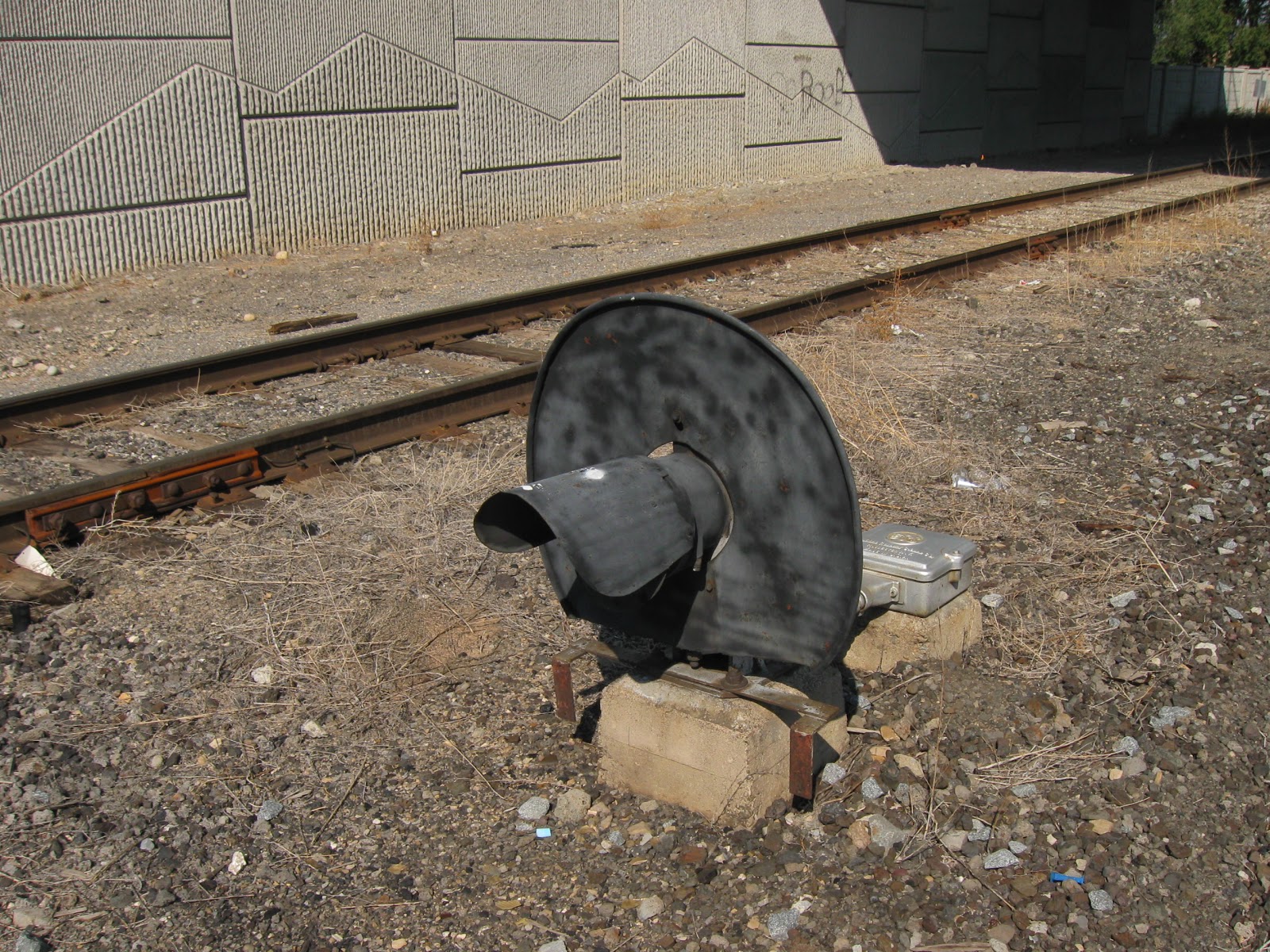
This little dwarf signal and accompanying switch stand control the junction with the Tintic Branch at approximately MP 0 (D&RGW main MP 695.8; Union Pacific MP 75) in Springville.


All taken September 2012.