Tuesday, December 10, 2019

A Look Back, Three Railfan Trips 2019: Part 1: Las Vegas and Kingman, Arizona


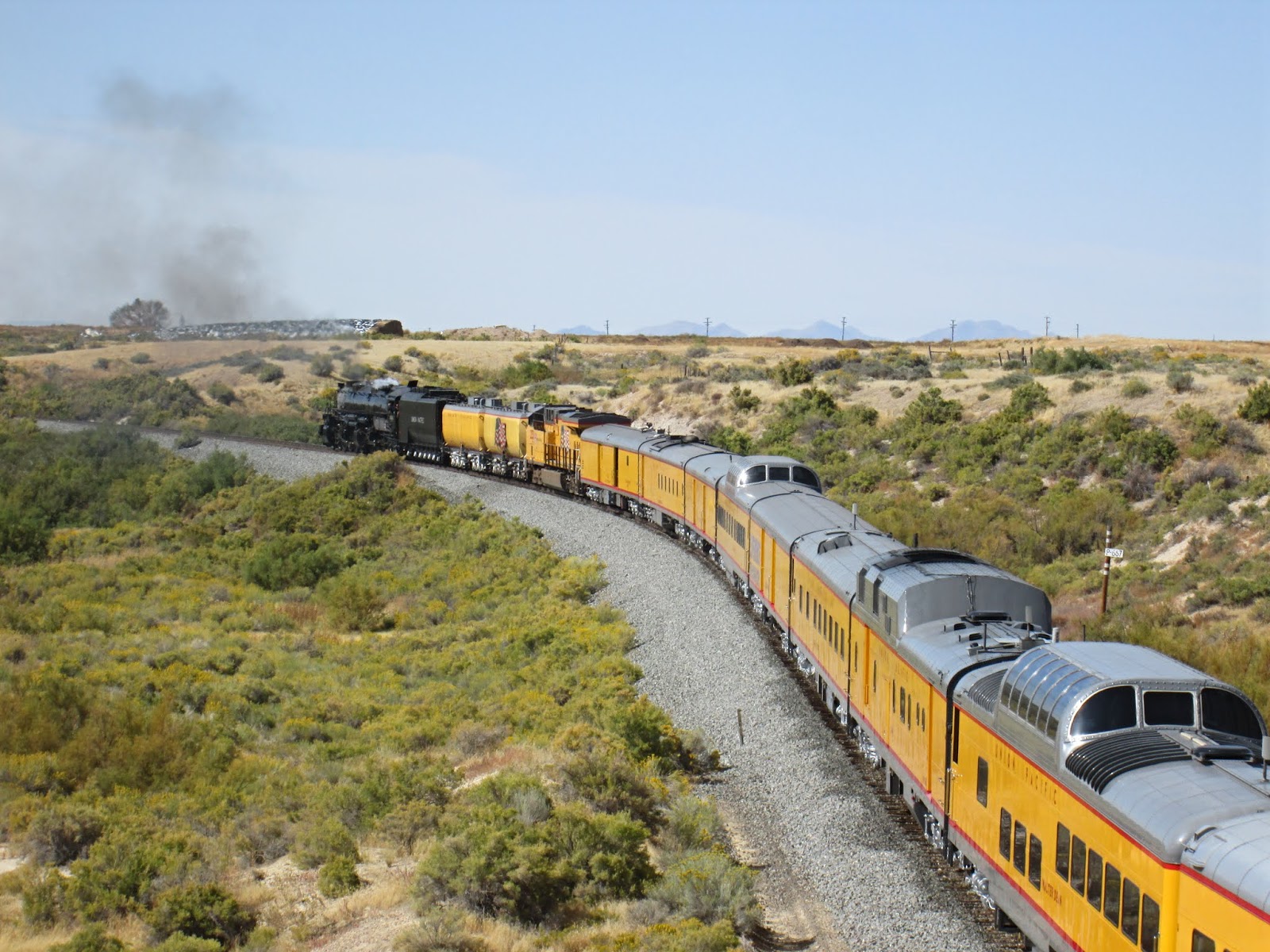
UP 844 leading an excursion train in Boulder City on the Nevada Southern Railroad on March 16, 2019;

This year I went on three major railfanning trips with friends. 2019 was always going to be a big year for railfans, with the long-awaited Golden Spike 150th celebration and the return of Big Boy to steam. Utah was bound to be a major location for all of these events, and it would host UP 4014 on two separate tours throughout the year.

However, I wanted to have experiences that were away from the bustle and crowds that the Big Boy would bring, and experience the 150th year of the Golden Spike throughout the west where I could see how the coming of the railroads changed life out here. It was also the first year in my life where my own family was not having any vacations of our own; my parents had decided to go on their first trip to Europe together and they made it clear that the only way my sister and I could join them was if we could pay for our own ticket overseas.

To be clear… their tour had them depart Utah to head to London on May 10th. I am sure most of the readers here would understand why I would not want to be leaving Utah on that day especially this year! Second, all of my own European fantasies seem to begin and end in Wales on the Ffestiniog and Talyllyn railway lines… and somehow the idea of touring London, Paris and Berlin was not the European trip I’d choose myself. Lastly, it was expensive; domestic traveling is much more affordable than international especially on a shoe string college student budget! So, I ended up joining up with friends to plan and execute our own vacations and trips this year across the American west. Sorry mom and dad, but maybe Europe next time.


January 3, 2019; was the day Dynamic Rail Preservation's two locomotives an F40PH and SDP40F left Utah on a freight train heading to Nevada. I captured a few photos of them while the train passed through the Tooele area.

Our first trip in March was born several months prior to that in January of this year; when Dynamic Rail Preservation finally moved its two locomotives stored in Ogden to the Nevada State Railroad Museum in Boulder City. We wanted to see DynaRail’s new home in Boulder City, and see how Nevada was treating Chris Fussell’s/DynaRail’s two locomotives. The next catalyst for the trip was the discovery that a piece of my hometown railroading history resided in Boulder City now. The International Smelting and Refining company had operated a steam crane known as “The Crab” in Tooele, Utah at their facility there along the Tooele Valley Railway. When the smelter closed “The Crab” was sold to the Heber Valley Railroad, and eventually was bought alongside other ex-HVRR stock by the Boulder City museum.

Lastly were the rumors that south of Boulder City, in Kingman Arizona was a land of milk and honey where the railroad action never stops on the former ATSF transcontinental railroad. Chris’s two locomotives, the BNSF action on the former ATSF and “The Crab” were the trifecta needed to launch a spring break trip to the Vegas area.

Joining me on the trip was Josh Bernhard; Desert Empire Project’s founder and one of our editors; and Schon Norris a former contributor to our blog and co-host of the Railroad Roll By Podcast with local radio DJ Todd Nuke 'Em. On March 15th I picked them up in Provo to begin our trek south to St. George where we would overnight before heading into Boulder City and Kingman the next day. I left behind a partially finished group homework project, I had done my assigned part and I figured my team mates would finish it before I returned Sunday night.

I-15 doesn’t offer much railfanning opportunities past Nephi where Union Pacific’s Sharp Subdivision begins to head west shortly south of town. So, for a bunch of railfans, this first leg of the journey was a caffeine fueled trek across Utah with not a lot going on other than our own idle conversations. It was the next morning, Saturday March 16th where our real fun began.

St. George is a marked contrast with the Great Basin Region, being the far end of the Colorado Plateau in Utah red rock country. I-15 drops off the plateau region through an Arizona canyon that straddles Utah and Nevada; then entering Nevada the altitude drops and the increase in heat marks the beginning of the eastern Mojave Desert. Seeing how northern Utah is still locked in winter, the summer like heat of the Mojave was a nice change of pace. I was a bit too excited to enjoy the heat, and forgot to apply sunscreen and ended up with a sunburned neck by the end of the day.

One of the Las Vegas Monorail trains glides past Harrah's and The Linq on the backend of the Vegas strip on March 16, 2019.

Our first major railfan stop was in downtown Las Vegas. We joked that we were in Las Vegas in spring break, not to see the clubs or casinos; but instead catch a sight of the monorail! The Las Vegas Monorail is a Bombardier system, based on the system first installed at Disney World in the 1970’s. We wandered on the back end of the Vegas Strip to watch the monorail as it climbed and crested the curves along its route. After sometime watching the monorail, we rushed back to our cars to head out to the Nevada State Railroad Museum in Boulder City.

The Nevada Southern Railroad rides along the former Union Pacific branch that connected the Hoover Dam construction site to the national rail network. The northern leg of the branch up to Henderson is still in service with Union Pacific; but the southern leg hosts the museum and their tourist trains. We arrived and the museum’s director Randy Hees and Braden Brickman one of the museum staff both guided us on a tour throughout the museum for the next few hours.

One of the projects currently at the Nevada State Railroad Museum in Boulder City is the construction of Dan Markoff's replica narrow gauge passenger car Elsa. This car will accompany his famous Eureka locomotive in future visits to narrow gauge railroads.

Randy and Braden were great hosts. They walked us through the railroad’s shops so we could see DynaRail’s locomotives up close in their new home, we even ran across DynaRail’s president and owner of the locomotives Chris working in the cab of UP 844 (the GP30) in-between tourist train runs. We toured a private parlor car kept in the museum, and got a kick checking out the “Jackass and Western” equipment that was used in NERVA nuclear engine tests by NASA and the Department of Energy at the Nevada Test Site.

A faded outline of the NASA logo is visible underneath the DOE emblem on one of the preserved Jackass and Western locomotives. The NERVA rocket would never fly in space, but the idea of nuclear powered rockets is still discussed as a future deep space method of travel.

Randy opened up the back end of the museum for us, so I got to get my chance to get up close to “The Crab.” We also got to see Uintah Railway #12 stored in the museum back lot. In-between all the historic equipment on display, we took occasional breaks to photograph UP 844 and the rail bikes coming in and out of the museum to head on excursions on the railroad line.


Faded red paint has turned to orange in the Nevada desert sun, but The Crab is in remarkably good mechanical condition.

Nevada Southern Railway 1000 was one of the first diesels on the Union Pacific. It would later work for the Western Pacific and the Sacramento Northern before entering preservation on the Heber Creeper. It moved to Nevada with a large majority of the former Heber collection in the 1990's.

I have to speak very highly of Randy and Braden for hosting us. If anyone is out in Boulder City area, I definitely recommend taking the chance to visit the Nevada Southern for themselves and experience it. It’s a great museum, that has plans to grow over the next few years!

UP 844 returning rail bikes to the museum's station platform.

Dynamic Rail Preservation 644 would be renumbered later in the year to its BNSF era "6967." Due to the work of Dynamic Rail Preservation and the Nevada Southern, the locomotive would return to operation in November 2019.

BNSF freight passes alongside the preserved ATSF era Kingman Depot. The station is still an active Amtrak stop after it was restored a few years back.

BNSF action on the double mainline just east of downtown Kingman.

After our time in Boulder City was over, we began our trek south to Arizona to Kingman. The long drive was rewarded with Barbeque in Kingman at the end; but we had to see for ourselves… was the ex-ATSF transcontinental really the fabled train mecca we had been told about? We already saw one train before entering the BBQ place, and we swore we could hear a few more pass while waiting for our meal… so as soon as we were finished eating, we rushed out to see the traffic.

Kingman did not disappoint. I had never before in my life seen so many freight trains in one place passing each other almost nonstop. BNSF runs a constant line of freight traffic along their southern Transcon all day; and every 15 minutes we were almost guaranteed another train passing through town. We were stunned, we’d move to one location and have a train almost as soon as we arrived; then when we’d discuss moving location, we’d start packing up our gear only to whip it out seconds later when we heard the distinct shriek of dynamic brakes coming around the curve. We were constantly bouncing around town, enjoying the constant action. 


"What the...!?!?" a trailing Union Pacific DPU on a BNSF freight gathered our teasing ire in Kingman Canyon. Another train with a Ferromex leader and a KCS unit trailing caught us by surprise.

Schon and Josh demonstrate the natural seating in Kingman Canyon.

We finally settled just off Route 66 in Kingman Canyon on top of a pile of rocks overlooking a pair of ATSF painted bridges. Josh, Schon, and I stretched out on the natural chairs formed by the rocks and just enjoyed the nonstop parade of trains along Route 66 from our perch. We got a few chuckles at the oddball Union Pacific or Ferromex locomotive, joking we traveled out here to see BNSF not these locomotives! Our jokes and obscenities echoed in the canyon, muffled by the growling prime movers on upgrade eastbound trains, and the whine of dynamics on the downgrade westbound. Dusk fell, and we packed up, grabbed gas for my car; then began the long drive from Kingman back to St. George.


Our discussion in the car became something of a meme among ourselves and our friends. We started debating the value of sound effects in model railroading, and the long debate over pro-sound anti-sound kept me awake while driving the long drive. Turns out Schon and I were very much in favor of locomotive sound effects, while Josh felt a more traditional soundless approach was truer to the hobby. After the long drive we finally pulled into St. George and grabbed some late-night Arby’s, before heading back to the hotel.

On March 17th, I took a break from Josh and Schon to visit my grandparents who live in St. George. My grandmother was suffering from dementia, and I was glad to visit her and spend time with her and grandpa; since grandma would end up passing away a few weeks later. I shared with them a few pictures I had taken in Boulder City and Kingman, hoping perhaps the photos of The Crab would jog a few memories from my grandfather who worked at the International Smelting plant in Tooele in his youth. After I spent time with my family, I returned to the hotel to meet up with the rest of the crew. While I was gone Josh and Schon plotted a route that would take us to Iron Mountain and then onto Lund, Utah up through Milford then along the Lynndyl Subdivision then the Sharp Subdivision back to Provo, Utah.

The mothballed locomotives at Iron Mountain just outside of Cedar City, Utah continued their long rest on March 17, 2019 when we stopped in the area to check them out. Once the lease expired on these locomotives, the lessor decided to scrap them on site later in the year.

Little did we know how that re-routed plans would begin to change our last leg of the trip into a different journey we’d never forget! We arrived easily enough at Iron Mountain, exploring the mothballed locomotive fleet and the branchline leading from the Union Pacific to the moribund iron mine through sharp hills and pinion pine trees.

My car at Lund was already looking terrible... I wish I got a picture of it before we reached Milford since it was already looking comically worse; but I think I was to frustrated to bother with grabbing a photo of it by then!

It was on route to Lund we encountered the first troubles in an early spring trip through the desert, wet muddy roads. My RAV4 limped through dirty roads into Lund, and we were a bit nervous but decided to stick to the dirt roads on the route north to Milford. Soon it unraveled into a disaster… my car was covered in mud, Josh and Schon had to push my car out of the mud while I tried to throttle the car out of the muck. A few grunts of frustration and profanities laced rants later, we eventually started bush-whacking through sage brush, the brush grabbing to my car’s undercarriage and beating us around. The bush seemed friendlier than the mud anyways.


We did manage to catch a few trains outside of Milford and on our route to Delta; but it felt sparse after the nonstop action the day before in Kingman, Arizona.

By the time my car rolled into Milford, it looked like it had come out of a jungle expedition. Sticks of brush plastered on with mud were glued to my car. Turns out Milford has no car washes… so we had to try and clean off my car with a gas station squeegee. We tried railfanning a bit between Milford and Delta, but compared to the feast of traffic the day before; the LASL felt like a famine.

In Lynndyl, I noticed my car started shaking as I approached 60 mph… we pulled over to inspect it, and I found more brush stuck in the undercarriage. The following trip over Leamington Canyon was a crawl, and getting into Nephi and back onto I-15 was a slow slog where we had to stick to the right line with emergency flashers on to Payson. I nearly considered abandoning my car in Provo letting Schon drive me home but I decided to stick with it and drive on the final leg back. By myself now, I crawled slowly across the valley’s back home… fortunately The Killer’s Hot Fuss album kept me company. I learned to love the bass lick of Jenny Was a Friend of Mine that night, as it kept me awake during the long limp home.

Thank you Brandon Flowers and Mark Stoermer, et. al. for giving me some music to stay awake to on that long slow drive home.

Then I got home only to discover neither of my teammates had done anything in the group project I had left that weekend. A late night was spent on my computer, waiting for them to finish their legs of the assignment before I could submit it in for its Monday morning due date! The next few days I was faced with paying for the repairs to my car transmission due to the damage caused by all the sage brush back in Lund.

Weeks passed, and somehow the legendary car disaster at the end of our trip morphed into legend; and I had over a thousand photos to admire from our trek. Somehow the group project came together in the end and I passed that class. Eventually May struck and after the Big Boy with its crowd’s and hysteria had come and gone… I decided it was time to do it again. I learned a few things… this time I wasn’t going to let my car get stuck in the mud!

-Jacob Lyman 

Want to hear more about this particular trip? Check out this episode from the Railroad Roll by Podcast where Schon talks about his views on the trip near the end of the episode.

Monday, December 9, 2019

Opinion: The UP 3985 Challenger Talk

Patience my fellow foamers.

Like some sort of rigged booby trapped explosive, UP 3985 has been coming up as a trigger point in countless railfan forums and Facebook groups over the last few years. With the increased interest in the UP steam program this year following the wildly popular UP 4014 tours, it seems plenty of talk has been made of 3985. Disparate clues that UP is planning to get working on it now that UP 4014 is finished, plenty of other firsthand reports claiming the engine is as good as dead and will continue its long term storage in the Cheyenne Roundhouse. Even more rumors suggesting its going to be packed up and stuffed and mounted in a museum. What exactly is going on with 3985, and why does the railfan community have such a fixation on it?

Do I have the answer to these tales of 3985's fate? No, I don't. I bet only Union Pacific themselves know the answers, and it seems for now we are just going to have to wait a bit longer to find out what they are planning (or not planning) for the engine. But I do want to share my opinions on the subject.

Mark Evans photo October 2008

1979 marked the beginning of UP 3985's return to service, when a group of volunteers began reassembling the engine in Cheyenne. The restoration was completed in 1981, and as part of the Union Pacific Steam Fleet it joined UP 8444 in public relations tours across the Union Pacific system. Among the highlights of this career was its 1992 use on CSX rails as part of the former Clinchfield Railroad's annual Christmas train. Another trip in that same era was the 1990 stack train run, where UP 3985 lead a stack train for APL. The final trip for the Challenger was in 2010, pulling the Ringling Bro.s Circus into Cheyenne; and the engine was stored pending its FRA mandated overhaul. A month later, in November; longtime UP Steam Program head Steve Lee who had been a part of the program for much of the Challenger's use, retired and was replaced by Ed Dickens. 

This is where I think of a lot of the hysteria surrounding UP 3985 began to take root. The changing of the old guard definitely ruffled a few feathers.  In 2013, UP 844 joined UP 3985 in storage and many online railfans went into a fury over the idea that this 'new guy' Ed Dickens had somehow allowed both of the railroad's steam engines to fall silent. 

However it is clear that Ed and his team were already beginning to focus on a much bigger task up ahead. In 2012 UP had announced their desire to re-acquire a Big Boy locomotive; and in July 2013 UP officially sealed the deal acquiring the now famous UP 4014 from its home in the Rail Giants museum in Pomona, California. 2014 was a big year, moving the Big Boy from its static display; and across four states back to Cheyenne to start restoration work. 

Still for many armchair critics, retired preservationists, and other railfans in the forums and chatroom's; it was unacceptable that steam was still silent on the Union Pacific (the pending Big Boy restoration not withstanding). Meanwhile the diesel fleet maintained by the steam program (the DDA40X and E units) slowly began falling silent too, furthering increased online speculation. Many began protesting the current steam team with some online petitions demanding Ed Dicken's removal from Union Pacific. It seems silly in hindsight, but the digital vitriol from that era was very real, and continues to haunt a few segments of the railfan community.
What followed was a stunning set of years, where Ed and his team proved their worth; first with a remodel of their steam shops in Cheyenne, the return of UP 844 to steam in 2016, and the final push to get UP 4014 ready for its grand May 2019 entrance. The chatroom hysterics seemed unfounded as 2019 grew to become Union Pacific steam's biggest year yet. 4014 would travel the nation in three massive tours, taking it up and down the Union Pacific system, celebrating the Golden Spike with UP 844 in Ogden, joining a preserved ALCO 2-8-0 in Duluth for a double steam display, pulling excursions up Cajon Pass, joining UP 4141 in honor of the late President Bush Sr. in Texas, and storming through snowstorms in Kansas and Colorado in a rush to get home before Thanksgiving. While many of the internet critics remained, their complaints fell on deaf ears as many who experienced UP 4014 in person (myself included) got to witness a spectacular showing from it through out the year. 

In person, its hard not to admire UP 4014. Clean and crisp looking its a modern and complete restoration to its core. The only part of 4014 I genuinely hated, was having to swim through the massive crowds that always followed to admire it! 


One of my favorite experiences with UP 4014 was its return to Utah in October, I chased it in Salt Lake City; and again a few days later through central Utah down from Provo to Delta.

What a year 2019 was! Thousands if not hundreds of thousands of people got to witness the largest steam locomotive in operation. I can't help but wonder what seeds have been sown, what little kid who was out trackside for UP 4014 this year might be the one with Ed Dicken's job in the next 30 years? Which one of those kids might be the next to helm the famous steam shops at Strasburg? Or the one to design the next leap in rail technology? This kind of publicity is excellent for our community, and UP 4014 has done marvels for railfanning and railroading this year. 

Of course though, the question returns eventually to... "what's next?" Slowly whisker tracks that had been removed for environmental remediation at the Cheyenne Roundhouse; are being put into place once again connecting UP 3985, the DDA40X and E units to the national rail network. Once these pieces of equipment are no longer "landlocked," will they join UP 844 and 4014 in the program's active roster?

As I said earlier... I am not the person with those answers. I do know what I want emotionally; the thought of three massive UP steamers in play is an awesome fantasy. The image of UP 4014, 3985 and 844 in a massive triple header is probably the holy grail of many a railfan's dream, and its been something I have spent time idly daydreaming about. Just as 844 was welcomed to communities it returned too after its 2016 restoration was completed, perhaps 3985 could do the same once more as it returns from its long hiatus. Perhaps a double showing of 4014 and 3985 could solidify UP's legacy as the railroad of true giants.

But the logical part of me asks... why? Why in the world would Union Pacific need three locomotives in their fleet? They don't often pull passenger excursions, the Cajon Pass and a brief segment of the Ogden trip being the only parts of 4014's trips this whole year with passengers on-board. Unlike a tourist railroad that can have two or three engines under steam at a time, UP often only needs just one engine running per trip. Part of the appeal of 3985 was it being a large articulated steam locomotive, but with 4014 in the stable now there is a larger articulated in town. Lastly with the corporate bean counter's over their shoulder's; would Ed even have a case to argue to corporate for the funding to restore 3985 when its clear 4014 and 844 can already draw the crowds? Would funding for 3985 delay the potential return of the E units and the DDA40X?

Like Pink Floyd said "Money so they say, is the root of all evil today..." and money will always be the bottom line in any steam locomotive's hopes for future operation. Just go ask Western Maryland Scenic and their long slow road to returning 1309 to operation... So if money is the key issue, unless corporate was willing to finance a three steam engine operation; it seems 3985 might only have a chance to return to operation if it replaces either 844 or 4014 in the future. This is where my opinion comes on strongly; if I had to pick two of the three and leave the third for storage... I'd pick 844 and 4014 any day over 3985. With the exception of the railfan's who have formed strong bonds to 3985; I imagine most of the railfan population, general public, and most importantly corporate heads at UP would likewise leave 3985 behind in their selections. Its hard to sell UP 3985 to corporate and the general public, when its simplest description is "imagine UP 4014, but slightly shorter..."

So then the question becomes... what to do with 3985? It has already donated some parts (most notably its tender) to 4014, perhaps it can join UP 838 as a part's source and template permanently stored in the Cheyenne shops? Or maybe its destiny lies in a museum, bring it out somewhere for display and permanently strike it from the UP roster? Or perhaps it is to sit collecting dust, until maybe a day comes when 4014's novelty wears thin and a replacement is sought for, or maybe UP's business head's hearts will grow three sizes one day and they decided they need that third steamer to complete the ultimate foamer dream team? Or is UP already planning a return to steam and restoration is secretly under way even as we speak?  

If I were a betting man, UP 3985 is going to stay exactly where it is at. I tend to lean on a lot of the accounts from this year's 4014 tour's where several railfans reported Ed or other steam crew mentioning there are no plans for UP 3985. No plan's means exactly what it says on the tin; no plans... no plans to donate it, restore it, scrap it, move it, or anything of the like. Personally, I think no plan is in a way, the perfect plan for 3985 right now... its safe and indoors; protected from theft, can serve as a parts template for 844 and 4014, and makes a great talking point for the occasional Steam Shop tours. I'd hope that the steam shop dedicates its forces to continued upkeep on 4014 and 844, and perhaps begins bringing its historic diesels back into operational shape; since the return of the DDA40X and E units could perhaps make more poignant diesel helpers for the two active steam engines rather than the current trend of using general UP freight engines. 

Again, I can't pretend to know with any certainty what is going on at the UP Steam Shop. But I think Ed and his crew deserve all the praise they can get for the restoration of 4014. I find the continued online hand wringing and bashing over 3985 odd; 2019 has been the most spectacular year for the steam program yet, but many railfans seem to not be seeing the forest through the trees continuing to focus on what hasn't happened rather than what has already happened. Our community can continue to get hung up on 3985... or we can enjoy the 4014 ride while it lasts and the present events we are all getting to collectively witness. When Otto Perry or Emil Albrecht witnessed the golden age of UP steam, do you think they could have imagined the crowds and excitement that would have been caused a half century later when just one Big Boy returned to service? Its an amazing world where every railfan across the globe got to witness the Big Boy in action thanks to digital streaming and social media bringing it right to them. 

As 3985's enjoy's its well deserved rest, I do hope that someday in some future it will once again breath with a fire in its belly and join its sibling engines in the UP Steam Fleet. Its the only one of the three UP steam engines I have yet to personally catch in action, and I hope to see it someday myself in steam. Until then 3985 will be fondly remembered by railfan's who got to witness it in action, while a new generation will get to come and know 4014 and 844 in these coming years. 

- Jacob Lyman

I should also mention, the 1982 fires caused by UP 3985 in Utah are personally one of my favorite "that's crazy!" stories that exists in railroading. If anyone wonders why UP 3985 and later UP 4014 became oil burners... well here's the answer: https://www.railpictures.net/photo/420353/


Saturday, February 23, 2019

Opinion: How I Would Fix Amtrak

Amtrak's California Zephyr; running several hours late, in Salt Lake City, Utah.

Lets be honest, the current Amtrak long distance train system has struggled to work for a long time. Since the system was founded in the early 70's, Amtrak has struggled to increase ridership and turn a profit in long distance train service. The long distance trains have also struggled to retain decent on time service, and recent cutbacks in dining car services on certain trains have sparked debate among travelers and rail-fans alike.

A classic streamliner scene on the Milwaukee Road in the mid-20th century.

A lot of the current operations of Amtrak's long distance trains follow the methods and style of the classic American long distance streamlined trains of the mid-20th century. Its hard not to see the appeal of this era of rail travel, lightweight passenger cars fitted with luxurious interiors, fine dinning services, and other luxuries designed to pull ridership back to the rails and away from the new airline and automobiles. This era still has a strong pull in the American psyche, such as Alton Brown discussing his first experiences eating a shrimp cocktail while riding a late streamliner era passenger train in his TV show "Good Eats", or the cinematic attempt making innuendos with the trains in the classic Hitchcock film North By Northwest.

Not only did the railroads compete with luxury as its weapon of choice, so did their competition in the sky. Airlines tried to bask in luxury in that era, putting kitchens into their airplanes that could dish out meals that rivaled those on the railroads (such as explained in this video). Meanwhile the car companies advertised the rising interstate system as a personal form of freedom, without the restraints of rail or air travel.

To railfans its hard not to see trains such as the 1950's Super Chief or the California Zephyr as the peak of American rail travel. The streamlined steam locomotives and bulldog nosed diesels certainly help the mystique, and I know I would love to have a full replica of some iconic named passenger trains in HO scale to run on model train layouts!


This is 2019. Airlines serve bags of peanuts to passengers in cheap seats that are painful to anyone over 4-foot 2-inches. The interstate system is complete, and long distance car travel is routine. And here is Amtrak, straddling the line between the 1950's passenger trains of old while trying to match the modern era of economy and low cost of their competition. In a strange way, Amtrak's service seems like a watered down version of the streamliners that came before, too cheap to be considered luxury and too expensive to be considered economic. Is it any wonder then that in 40+ years of operation Amtrak has still yet to find a working method for long distance trains?

Meanwhile, in city's across the nation short distance train travel is returning in force. In Salt Lake City, I am lucky to have easy access to the TRAX and Frontrunner systems, and similar streetcar-light rail-commuter train systems are popping up in metropolitan areas across the nation. America is falling in love again with these short distance trains in their local area; cheap and economic, and easily accessible to the masses.

That is what makes the recent Wall Street Journal article about Amtrak considering re-inventing its long distance trains so intriguing. I see it as taking a page out of what commuter rail is doing and bringing it to Amtrak's intercity model.

For example, lets say I want to travel from Salt Lake City to Denver via train. Does the current California Zephyr really service my needs? I'd first have to get on a 3:30 am train in Salt Lake City, in a neighborhood that has limited parking options and is infamous in the area for its homeless population. If I could park off site then ride TRAX in that would be preferable, but TRAX isn't running at night when Amtrak makes its Salt Lake stop.

Then I'd travel most of the scenic former Rio Grande in Utah in darkness. At least it will be morning when I hit the Utah-Colorado border on the train, and I would be able to enjoy the Moffat Route in daylight, although I think it would be hard to shake that I missed half the scenery already. The arrival at 7:10 pm in Denver is sort of a more normal arrival hour and it will be at the refurbished Union Station; but much of the same troubles repeat on the return route with a return to Salt Lake City being about 11:00 pm at night.

Simply put, its not convenient hours and not competitive to similar airline service. The appeal of using Amtrak to travel outside of Salt Lake City is not very strong. Not to mention, its completely limited to the California Zephyr route... Oakland, Reno, Denver and Chicago are about the only major cities I can reach via the CZ without taking connecting trains or bus routes. I have had far more trips to Los Angeles for somewhat regular visits to Disneyland and treks up to Seattle to visit my family than I have ever had to Oakland or Reno (I have never been to Denver or Chicago). The point being, the California Zephyr not only has the wrong departure times, it also has the wrong destinations...

And that is why the proposal to run shorter daylight trains on more direct routes between cities Amtrak is looking at is so tempting. Its a sacrifice of the last vestiges of luxury for sure, but it could be the full embrace of economy and ease of access that Amtrak sorely needs. Trains Magazine contributor Fred Frailey has discussed the issue in a recent blog post called Amtrak's Great Debate begins, addressing both the legal and planning hurdles the changes could face; while also showcasing the potential. Frankly, it is time for this "Great Debate" to start and I am excited at the possibility of a 'new' Amtrak.

For inspiration, why not look at the Western Pacific's Zephyrette; an RDC motorcar service that was meant to be an 'off hours' counterpart to the California Zephyr? Lets take this model to the modern era and see how it works.


First, lets take a modern DMU unit such as the Stadler FLIRT or Siemens Desiro (what can I say, the Europeans build good trains!). Lets outfit it for longer distances, bigger fuel tanks so it can make runs from say Salt Lake to Las Vegas without refueling between terminals. A portion of one car will be a luggage rack for passengers to store their carry on bags. Lets add a small concession bar, so riders can get some cold served sandwiches and some snacks so they can have a small meal or two en-route. No-where near as glamorous as a three course hot meal, but still comparable to similar services seen in airline travel (besides what is to say a passenger couldn't pack their own meal for the train?). Outfit the train with Wi-Fi and maybe some on-board TV screens to entertain the commuters who might not be captivated by the scenery. This train will be staffed with an engineer, a conductor or two who will aid in ticket checking and passenger boarding, and some staff to run the snack bar.

Two trains will be staged at opposite terminals, one in Salt Lake and the other in Las Vegas. Both will depart early in the morning around say 8:00 am or so to coincide with the commuter rush in their respective cities so passengers can use public transportation or off site parking to reach the stations. We can maybe add one additional station stop in the middle of the route (in this case such as Milford or Caliente) so we can do a much needed crew change and provide some service to more rural communities.

Without large dining, luggage, parlor cars, or other classic streamliner trappings; our relatively small DMU is a fast little train, able to zip along the single tracked line between the two cities without fouling sidings for long. This is important to ensure the dispatchers of our host railroad are welcoming to these Amtrak trains darting between their freight traffic. It will likely be late afternoon before the train could arrive at the end of the line, but our passengers have successfully traveled from one city to another! If our Vegas bound passengers want to travel further, perhaps the train could connect with another DMU service that runs the Vegas to Los Angeles route.

Another benefit of using DMU's is it lowers the cost compared to having to maintain or buy a full 11 car train set like the current long distance trains need. This could allow for an increase of train frequency, with maybe two or three DMU trains departing a city terminal daily. Maintenance could be provided by either constructing new repair facilities for the DMU's near the routes, contracting services to local area commuter lines such as Utah's UTA or Los Angeles's Metrolink; or any remaining Amtrak long distance trains using traditional methods could be used to return DMU's to Amtrak's already existing facilities across the country.

Of course this plan has hurdles. Terminals would have to be expanded to handle having several DMU's at a time, in comparison to handling only one or two long distance trains per day. Of course the spending in purchasing the new DMU fleet and arranging to maintain it would be another hurdle. Most importantly, the very laws governing Amtrak and its definition of train service would have to change, allowing for Amtrak to implement these shorter routes without needing funding approval from individual states.

But I think the benefit on a focused model of smaller trains, shorter routes and more frequent service is tempting. Yes, it would be sad to see the departure of the long distance trains; but the continued long distance service has proved to be uneconomical and unsustainable financially year after year. Short routes and short trains could very well be the change Amtrak needs to be more economical and competitive in a modern United States.

I hope this "Great Debate" ushers in positive changes for Amtrak. Its about time this conversation started and I hope it modernizes American rail service for the 21st century!

-Jacob Lyman


Saturday, September 15, 2018

Opinion: Its Time to Preserve the West's Smelting History


Its been a while since I have gone to the blog to write a long form post; but a recent scroll through my Facebook feed brought up something interesting, which I have screenshot-ed in the above photo. I have never been to Superior, Arizona and not studied up much on its history... but the loss of any building related to copper smelting history is something I take notice of.

From what I read about the demolition currently ongoing in Arizona is that the buildings were briefly considered for preservation. However the amount of asbestos, arsenic, lead, and copper contamination was high enough that it was decided for health and safety reasons to demolish the remaining smelter buildings. One cost estimate pegged the cost of demolition at $2 million dollars, the other option to clean and rehabilitate the site and preserve the buildings? A whopping $12 million! (Source)

Non-ferrous metal smelting is a vital piece of our industrial history that is rapidly being lost across the nation and falling through the cracks in terms of preservation. Many artifacts from these smelters have made it to local museums, but nowhere has an entire plant in the western USA been saved and preserved. The experiences a railfan can have walking through the historic yards in Ely, Chama, or Jamestown and experiencing the entire site cannot be replicated with non-ferrous smelters. Yes, there are preserved mines & mills; but the smelter represented a critical link in the metal's process from ore to final product.

As of 2018, only three operational copper smelter's remain in the nation, Rio Tinto's plant at Garfield which serves as a backdrop for my daily commute, and the two smelters in Arizona. The last primary lead smelter in Missouri shut down a few years ago, the local mines now shipping their lead ores overseas.


Bethlehem Steel during the early 20th century depicted in a post card. From the Library of Congress.

Ferrous smelting has fared a bit better than the non-ferrous smelters in regards to preservation. Several steel mill remains east of the Mississippi have been preserved, cleaned up and redeveloped into the communities. One of the most notable examples of this exists in the Lehigh Valley area of Pennsylvania, were the former Bethlehem Steel plant has been converted into an event center called SteelStacks. A large portion of the plant is kept as a backdrop for the event center, most notably the massive furnace structure which is over 1000 feet long from one end to the next! The site made its way into the news again this year, as the neighboring Sands Casino began plans to purchase the structure and the city entered in talks with the Casino on how to preserve the 'stacks' for the future (Source). These sites will remain a part of the local history for years to come thanks to the preservation minded outlook of the local area.

However, in terms of Western United States history, the west was not built on steel mills the same way as the east (exceptions existed of course, such as Geneva Steel in Provo and the many small mills that work on scrap metal recycling that still run to this day). The dominant force of smelting in the west's history has always been copper and lead; with the gold and silver trapped in those ore bodies.

What remains of the great copper and lead smelters of the west today? Trips to visit the great smelting sites at Kellog, El Paso, Murray, McGill or Tooele end up either in a grassy field with a lone structure or two; or an area so heavily re-developed not much remains of the old plant. Tailings and slag piles might remain, but these toxic remains tend to be removed or blocked from access due to their environmental risk. One of the few preserved smelter structures in the west is the smokestack that once served the Anaconda, Montana smelter... but now it stands alone; a structure out of context. Again, any similar preservation efforts in the west are often single buildings without the surrounding plant or simply moving artifacts off site prior to demolition of what else remains. 


Bunker Hill Smelter in Kellog, Idaho in the 1970's. (Source)

I should clarify I do not intend to raise this issue as an attack directed on work such as the Superfund program. I believe it is important that areas be cleaned up to improve health and quality of life surrounding the site, and it would be economically unfeasible to preserve historic structures and clean up toxic areas at every single smelter site in the west. However, it is unfortunate that in the effort to clean up these areas that not one or two sites have been able to do such while preserving the historic plant.

This may just be the opinion of a lone amateur railfan, but when the next great smelter closes; be it Garfield or one of the ones in Arizona; and the million dollar price tag between clean up and restoring the buildings for preservation, or to simply demolish them comes up... I hope that the powers that be take the more preservation minded option next time. An entire preserved smelter plant in the western USA could be the next great historical landmark, a reminder of our nation's industrial history both the good and the bad. The preserved site could be a key learning tool in understanding the environmental, economic and cultural aspects of our actions. That is simply a story that can not be told with a bare grassy field.

-Jacob Lyman
Friday, May 11, 2018

Railfanning Disneyland: An Amateur Guide

May 10, 2016; Disneyland Railroad #1 on static display at the New Orleans Square Station.

While thinking of what I could write about the famous Disneyland Railroad, I have to be honest I kind of struggled thinking of what I could say about the history of the route that hasn't been said. The Disneyland Railroad is one of the most famous steam operations currently running, with some estimates suggesting over 6 million+ people ride the railroad each year. Disney trivia buffs can tell the stories of Walt Disney and his Carolwood Pacific; his friendship with animators & railfans such as Ward Kimball and Ollie Johnston; the stories of how Walt himself would come to the park to run his trains on the line, etc. As interesting as these stories are, I honestly have nothing new to say to those stories than what has already been stated prior by other authors.

However, one thing I feel is worth discussing is how to actually railfan this famous line and its sister rails in the resort, the Red Car trolley and the Disneyland Monorail. Truth be told, my recent experiences on a family vacation have proven to me that this line is one of the most frustrating and difficult railroads to shoot. There is no finding a peaceful lineside spot to watch the rails with few obstructions, as the realities of the theme park crowds make that near impossible. Not to mention that very few of us have the luxury or desire to devote our complete time in a theme park to railfanning (those hard earned Fastpasses for Space Mountain ensure that much). However, some recent reroutes have opened up the line to some new photo opportunities that are worth discussing and I hope my experience can be useful for future railfans who visit the park. By no means, I am not an expert; so don't be surprised if I missed out on some favorite railfan spot some of the frequently visiting Annual Passholders who frequently visit the park may be aware of which I am not.

May 6, 2018; Monorail Orange glides above park guests at the edge of the resort.

In terms of easy railfanning opportunities, the quickest system to access on the resort is the Disneyland Monorail. While the other lines I mentioned are confined inside the theme parks themselves, the monorail system runs outside the parks and through the public resort areas and alongside the right of way of Harbor Boulevard. As such this is the only system that can be photographed well without purchasing a park ticket. Even better, the segments of the monorail that glide outside the parks are relatively obstruction free in comparison to the cramped spaces in the parks themselves.

May 6, 2018 Monorail Blue glides along the edge of Disneyland Park after exiting the esplanade.

The line has three operating Mark VII monorails which are known by the color of their paint scheme, Red, Blue & Orange. The units are powered via a third rail (or is it second rail?) that runs along the monorail track. There is also at least one diesel powered tug on the line which is used in maintenance and to rescue stranded trains in the event of an electric power failure. The line has two train sets at a time running with the third kept in the rail shop backstage. During my most recent trip for example, only Blue and Orange were operating on the line.


May 6, 2018; shots of Monorail Orange traveling through the esplanade.

Those who wish to ride the monorail system should know the line has two stops; one inside Disneyland Park and the other in the Downtown Disney shopping district. The track also passes through Disney's California Adventure and the Grand Californian Hotel & Spa but makes no stops at either location. The gauge and system used at the Disneyland Monorail is unique to the line, based on the ALWEG designs from the 1950's (the sister Walt Disney World Monorail in Florida should be noted as the basis for Bombardier's INNOVIA system, which is in use in Las Vegas, Newark, San Paulo Brazil and Riyadh Saudia Arabia).

May 9, 2018; a Red Car Trolley traveling along the Hollywoodland facades.

The newest rail system in the Disneyland Resort is the Red Car Trolley in Disney's California Adventure park. A historical leaning railfan should be able to recognize this system is inspired by Los Angeles's famous Pacific Electric interurban system; the demise of which inspired the plot for Disney-Amblin's animated-live action hybrid film "Who Framed Roger Rabbit." The Disney version is an electric street running system with four stations.

May 9, 2018; The Red Car about to depart from the station near the park entrance at Disney's California Adventure.

The most onerous aspect of railfanning the Red Car is the fact that theme park streets are very crowded. It takes some patience waiting for crowds to split long enough to get an unobstructed view of the trolley system in action. Fortunately, the entire right of way of the line can be followed via walking along Buena Vista Street and Hollywoodland; except a small portion which is "backstage" on the property. Keep an eye out for regular shows to were singing newsboys will ride along the Red Car from the backstage area to a performance area near the park entrance.


Of course I should mention one of the best part of the Red Car system... the set of Wig Wag crossing signals that follows the line! I have no idea if these are authentic or replica pieces, but it is still pretty fun to watch the Wig Wags in action.

It is worth mentioning that Disney also some a 'fallen flag' railroads! The "Jolly Trolley" was another streetcar system that looped around the Toontown area of Disneyland. The tracks remain and one of the trolleys is kept on static display in the land, but the system has not been used since 2003. The other is the mine train ride system that is best known as "Mine Train through Nature's Wonderland." This small system traveled through the western themed Fronteirland as part of a scenic attraction. It was eventually replaced with the highspeed rollercoaster, Big Thunder Mountain Railroad (again a rollercoaster and not quite a proper railroad despite the fun train theme!) One of these old mine trains used to be on display in the park; weathered to look like an abandoned locomotive, however it has since been removed. Perhaps the most famous shortlived Disney railroad was the Viewliner, which was based on GE's revolutionary Aerotrain (Union Pacific would use an actual Aerotrain set between Los Angeles and Las Vegas as part of its "City of Las Vegas" train, and ATSF would use one between Los Angeles and San Diego) The Viewliner was retired when it was replaced with the early Monorail system.


May 7, 2018; Ernest S. Marsh former Raritan River Sand Co. #10; a rebuilt Baldwin which is now a 2-4-0 pulls an excursion train along the newly laid reroute alongside the Rivers of America

Now lets discuss the main attraction itself... The Disneyland Railroad and its five 3' gauge steam engines. Each engine has a unique name, the first four named after historic presidents of the ATSF and the : 
  • #1 C.K. Holliday; RETLAW, 1955
  • #2 E.P. Ripley; RETLAW, 1955
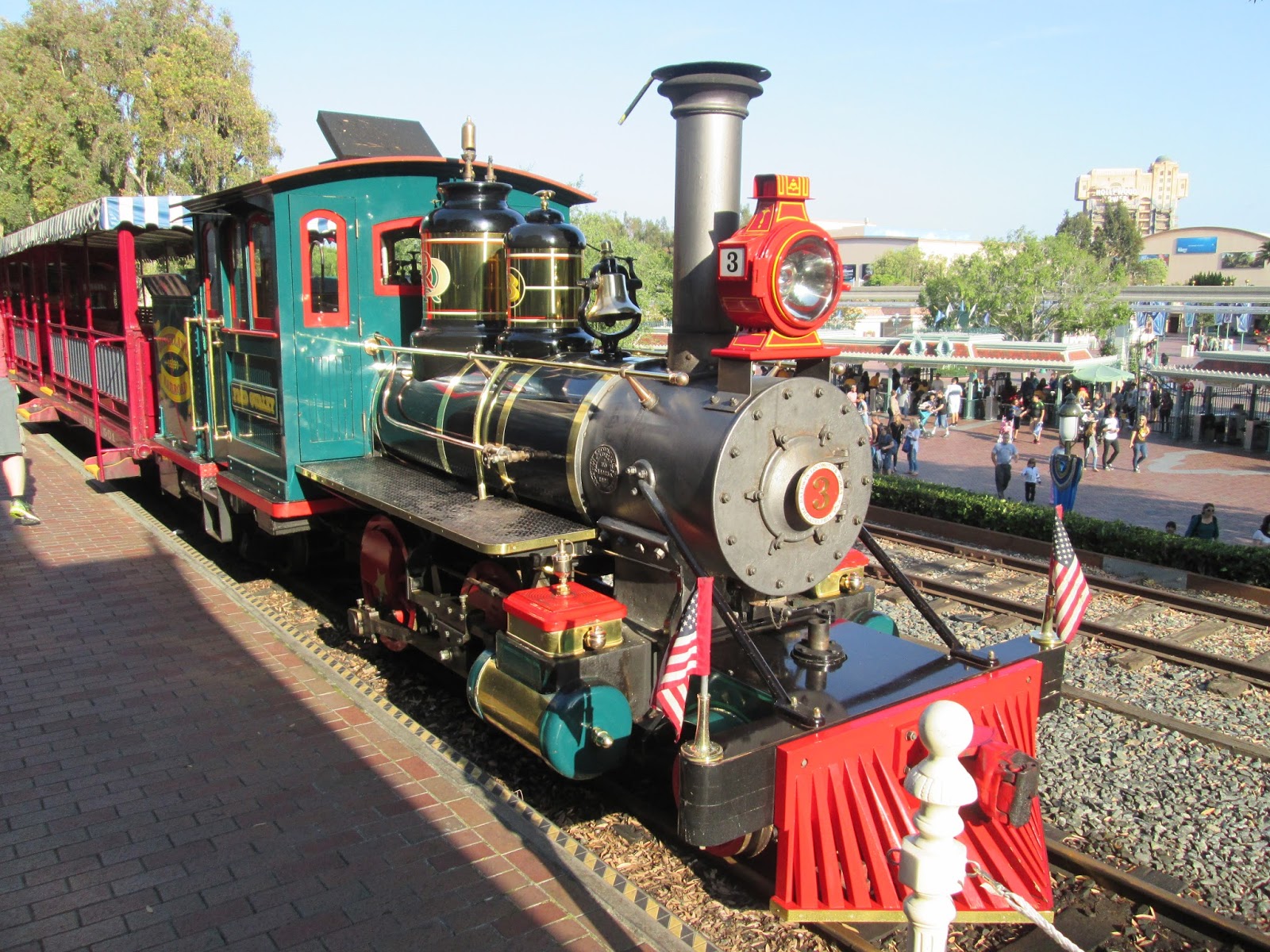
  • #3 Fred Gurley; Baldwin, 1894
  • #4 Ernest S. Marsh; Baldwin, 1925
  • #5 Ward Kimball; Baldwin 1902
#1 & #2 were built by Disney under the name of his private company "RETLAW" (Walter spelled backwards). RETLAW managed the Disneyland Railroad, the short-lived Viewliner, and the Monorail, in their early years separately from the main Disney company to ensure Walt could easily access his trains and retained ownership over them. #3 and #5 are both Baldwin built Forney locomotives which have been heavily modified with pilot wheels. #4 was also heavily modified, with the addition of pilot wheels. The line has also been visited by two other locomotives; the operational "Marie E." a 0-4-0T and the inoperative "Chloe" a 0-4-2T owned by the Orange Empire Railway Museum.

May 7, 2018; two Disneyland Railroad employees at the station at Main Street.

As I was saying earlier... this line is frustrating to railfan due to the amount of trackside obstructions and the weird angles on the circular route that make it tricky to find good lighting (in addition to the fact that chances are any trip to Disneyland is going to not be 100% about trains and instead focused on the countless other attractions to see and do in the park!) Not to mention nearly a quarter of the line is inaccessible for a trackside view since the train is passing the Grand Canyon and Primeval World displays. Oftentimes the best view of the train is as it is approaching one of the line's four stations.

Disneyland Railroad #5 the Ward Kimball approaches the New Orleans Square Station on May 7, 2018. As far as stack talk goes, this old Forney based Baldwin was one of my favorite sounding engines on the trip as it had to turn its little wheels at a quick pace to keep up speed on the reltively slow but busy line.

My personal pick for the best station to watch the trains is the New Orleans Square station. Operationally, this is where the realities of working steam engines can be best viewed by a casual onlooker. A water tower is here, were the trains regularly stop to take on fresh water to re-fill the tender. A trackside vent is placed at the end of the station platform, so a blowdown can be performed at the station while taking on water. The vent moves the hot steam to an outlet behind the station building, safely away from the throngs of packed park guests.

May 10, 2016; the New Orleans Square Station is backdropped via this beautiful wood station which served as the park's original Fronteirland Station. It is based on a station set built for a Disney film and recycled on Ward Kimball's Grizzly Flat Railroad. The station structure is normally off limits to guests, however the platform was accessible during a special display through-out 2016 while the line was temporarily out of operation.

Also New Orleans Square has a great environment to keep one busy between train watching in the area. Live jazz music can usually be heard from street performers; and several eateries nearby sell the park's Mint Julep (a non-alcoholic lemonade-mint concoction named after the bourbon cocktail from the Deep South) and the famed Monte Cristo sandwich. The classic wood style depot is a great backdrop, and the exit platforms of the station are a good place to wait for the trains.

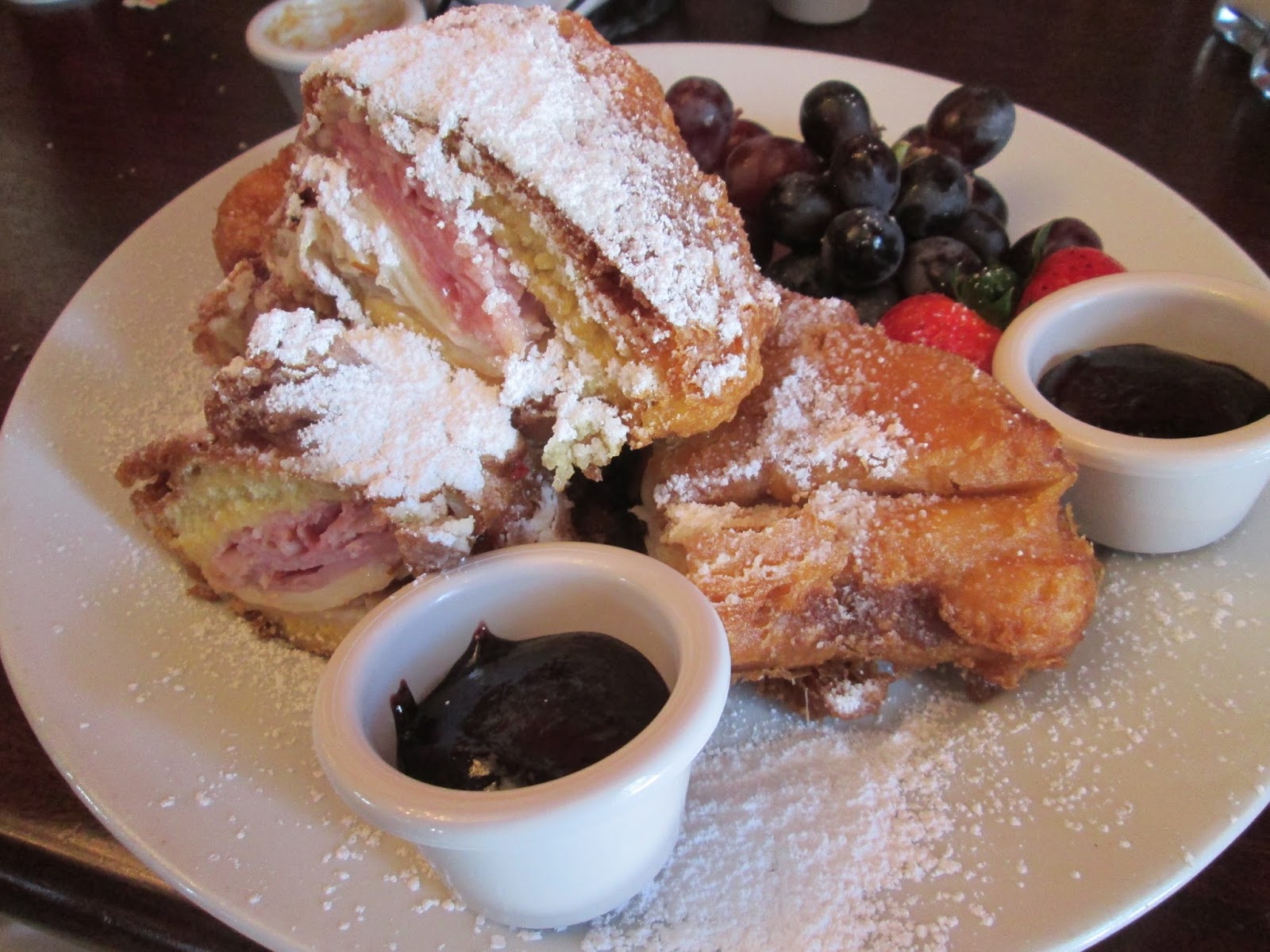
I know this is not train related, but can I just talk about how amazing the Monte Cristo sandwiches are? Meat & cheese in a sweet doughy bread; deep fried and covered in powdered sugar? Its like a scone with a panini buried inside. Its a rich meal, so I recommend ordering one set of sandwiches and splitting it with someone else; since half the plate is enough to fill up one adult. Then take the short walk from the restaurant to get back to train watching at the nearby station!

Now the Star Wars Galaxy's Edge expansion and the rerouted train route have opened up a few new opportunities to see the train, which while not perfect; are some of the funner places to watch the trains roll by. The back patio of the Hungry Bear Restaurant and the trail leading to the future Star Wars expansion have a good view of the tracks as they snake above the rivers. Its here where I like to think of Disneyland as a "large scale" model railroad layout, as the small artificial hills with their forced perspective tricks are not to dissimilar to many a setup I have seen in 1:87 scale. It kind of reminds me of the Durango & Silverton's crawl above the Animas River... just a lot smaller and with a lot more handrails surrounding the train tracks; and music and narration blasting out of every speaker on the train into my ear! A well timed trip on the Mark Twain paddleboat might offer a chance to see the trains up close on the new river front area.


Some of the views of and from the new train route through the Rivers of America. The Star Wars Galaxy's Edge expansion in the distance will be partially obscured once the new trees grow in.

A few of the other opportunities to train watch in the park that I have found interesting include the new red rock section alongside the back end of the Big Thunder Trail (new additions from the Star Wars expansion. Keep an eye out for a Union Pacific marked barrel and a small RPO stand replica while riding the train through here). Another spot is near "it's a small world" which is near the engine house for the train and includes the line's only grade crossing. While its can't be reached to photograph (unless on the train itself), listen closely for the train to give a the distinct long-long-short-long signal on its whistle while its crossing the road. 

It should be worth noting that all the viewing areas on paths near the Star Wars expansion are currently pretty peaceful and calm. However I doubt this will last after 2019 when the new expansion opens and crowds will be rushing into the Star Wars areas.

Of course, those who want a closer experience to the Disneyland Railroad than just riding the regular excursion cars and or watching it from the trackside have a few options at hand. One is trying to get a tender ride on one of the steam engines (#1, #2 and I think #4 all have seats for tender rides, while the two Forney based engines do not).  I had the fortune to have the opportunity to ride in the tender of the C.K. Holliday in 2005. My Disney trip this year though I tried twice to get a seat on the tender, but I was out of luck in both my attempts and couldn't get that coveted riding position. Seats are also available in caboose's when they are running. The line runs a parlor car, the Lilly Belle; a refurbished RETLAW coach from the original days of the railroad which is also a coveted riding opportunity not normally available to park guests. The best bet to get onto any of the special seats on the railroad is via asking at the Main Street Station at the front of the park, however as I previously said guests should be aware its sometimes tricky to have the timing work out right to get on-board the special seats. Despite the 'Mickey Mouse' nature of the whole operation, the Disneyland Railroad is indeed a real working steam railroad and the nature of such makes it tricky to arrange opportunities for tender rides or other special seating on every trip in the park.


Disneyland Railroad #3 Fred Gurley and the Lilly Belle bask in the morning sun while on static display during May 2016 at Main Street while the railroad was closed for construction.

A famous and more regular way though to get to see the Disneyland locomotives up close though is at the annual Fullerton Railroad Days. Over the last few years Disney has been sending one engine to display at the depot during the special event, giving railfans the chance to get up close to the engines outside of their park habitat. Another opportunity to experience the railroad in unique ways includes The Grand Circle Tour a reserved train with rides in the Lilly Belle parlor car. I know of some people who have been able to get in and tour the enginehouse itself, however if that was via a tour event or just special connections I have not been able to verify how they did it. The enginhouse is interesting, since its a two story building with the steam trains on the bottom floor and the aforementioned monorail on top! A brief glimpse of the enginehouse can be seen after departing Toontown and looking to the left of the tracks while on the train ride itself. A far easier to see look at the trains is currently in the Main Street Opera House, with a Disney train dedicated pre-show prior to the Great Moments with Mr. Lincoln attraction.


I hope my little guide and thoughts on railfanning the rails through the Disneyland Resort are useful. I am not some sort of local railfan with an Annual Pass who can drop by Disney regularly to scout for the best photo spots, but instead an out of state guy who gets the chance to drop by every two years or so; in case anybody else has some better insights on how to railfan the route please let me know in the comments. Until then, I hope future railfans on vacation get a chance to have a "Zip-a-dee-doo-dah" of a time while railfanning this uniquely American narrow gauge line!

-Jacob Lyman


*Note: While the Disneyland Railroad does not have an easily accessible behind the scenes tour currently, the sister operation the Walt Disney World Railroad at the Magic Kingdom in Florida has a lengthy "Behind the Steam" tour which I have heard great things about.

*Note two: I have excluded both Casey Jr. Circus (which is actually a proto-rollercoaster flat ride thing); and the horse-drawn trolley cars that run up Main Street from this list. I figure both could have qualified for this article, but I figured they were not going to draw as much attention from railfans as the other lines and photographing them is rather self explanatory while in the park. I also guess every roller coaster in the park could qualify as a "train" but no, I am not going to go there today!